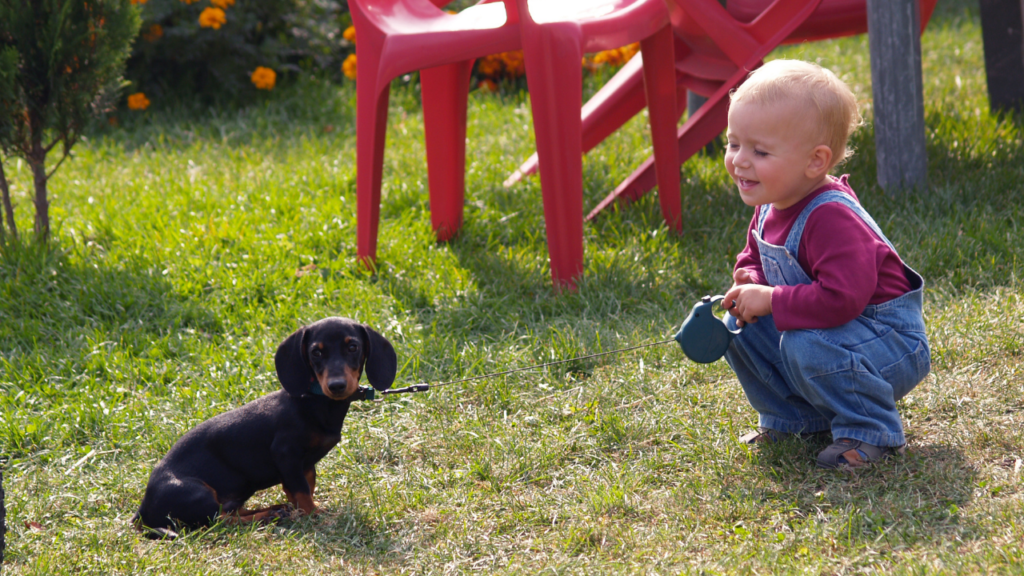
A Dachshund can be a wonderful family dog for households with children, but only when parents truly understand the breed’s personality. This is a small dog with a big temperament – stubborn, brave, and deeply attached to its family. Dachshunds need clear boundaries and calm, respectful interactions with children.
Although they may look small and harmless, Dachshunds have a strong hunting instinct and a mind of their own. That is why, before making the decision, it is worth understanding not only their strengths, but also the traits that can become challenging in everyday family life. In this article, you will find everything worth knowing before choosing a Dachshund for your family.
Why dachshunds and children can be a great match
A size that works in your favour
A standard Dachshund weighs around 7 – 9 kg, while a miniature Dachshund usually weighs up to 4 kg. This makes them manageable even for older children to walk on a leash, while still being easy for an adult to safely control if needed. Compared to larger breeds like German Shepherds or Labradors, a Dachshund is less likely to accidentally knock a child over during play – even though their energy levels can be just as high.
An important note for apartment living families: Dachshunds adapt very well to flats and smaller homes. They do not need a large garden – they need walks, scent exploration, and connection with their family.
Energy that matches a child’s lifestyle
Dachshunds are full of personality and energy. They love fetch, hide-and-seek games (yes, really), running around the garden, and joining in on every family activity as if they were a full member of the team. Children between 5 and 12 years old often become their favourite playmates because they are active, playful, and energetic – just like the dog itself.
Fun fact: Dachshunds were originally bred to hunt badgers underground. Their instinct to track, sniff, and explore is deeply rooted in their DNA. Shared “adventures” around the garden or outdoors can genuinely become one of their favourite activities.
Loyalty that stays with you
Dachshunds form incredibly strong bonds with their people. Children who grow up with a Dachshund from puppyhood often remember them as their first true best friend. These dogs remember who cuddled them, who slept beside them, and who secretly shared food under the table. In return, they give years of affection and devotion.
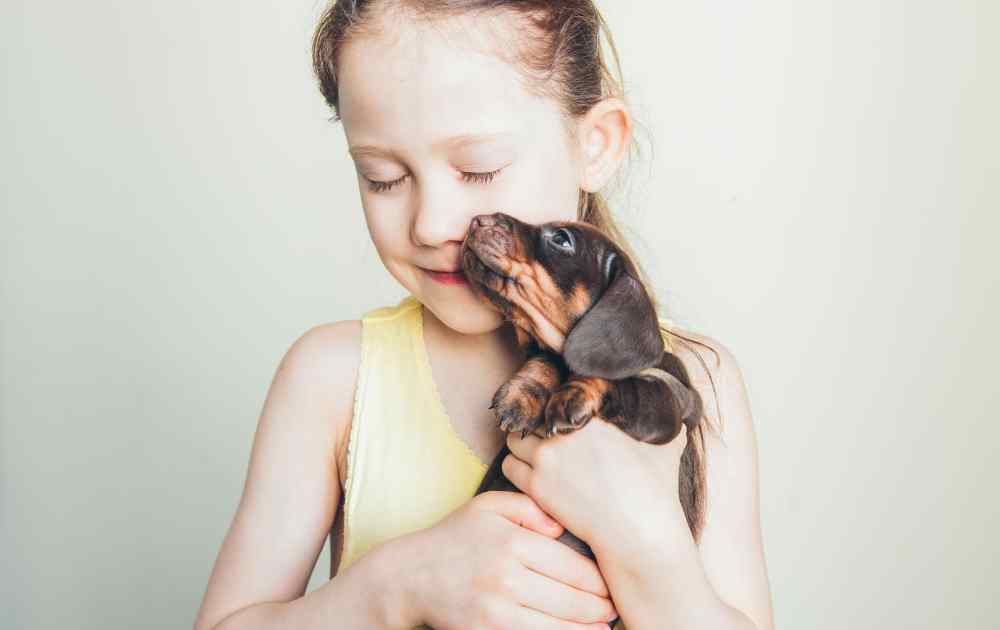
Dachshunds and children – what you need to watch out for
The spine – the most important thing every parent must understand
This is the absolute priority. Dachshunds are predisposed to intervertebral disc disease (IVDD). Their long spine combined with short legs creates a lifelong risk of back problems. Incorrect handling by a child can lead to serious or permanent injury.
Teach children one non-negotiable rule: always lift a Dachshund with two hands – one supporting the chest behind the front legs, the other supporting the hindquarters. Never grab the middle of the body, never carry them awkwardly, and never allow repeated jumping from high furniture.
This is not just advice – it is essential for safe daily life with the breed.
Hunting instinct – when a running child becomes “prey”
If a young child runs away squealing, a Dachshund may instinctively start chasing – not out of aggression, but because of deeply rooted hunting instincts. Usually the situation is harmless, but it can still end with both sides frightened or overwhelmed.
The solution: teach children to stop and stay calm around an overexcited or stressed dog rather than running away. Calm, predictable behaviour from children is extremely important.
Dachshunds are assertive dogs with boundaries
Dachshunds are not known for endless patience. They will not tolerate ear pulling, tail grabbing, or rough handling forever. Compared to breeds like Labradors, they are quicker to growl or show discomfort when they have had enough. This is not aggression by nature – it is communication. The challenge is that young children often do not recognise canine body language.
One essential rule: your Dachshund must have a safe space, such as a bed or crate, where children are never allowed to disturb them. Respecting this teaches children healthy boundaries while protecting the dog from stress.
Which dachshund is best for a family with children?
Miniature or standard Dachshund? It is a question many people overlook, but it matters.
A miniature Dachshund (up to 4 kg) is physically more delicate. In homes with very young children, accidental injury becomes more likely. They are usually better suited to families with older children who already understand how to handle small dogs gently.
A standard Dachshund (7 – 9 kg) is generally more resilient in a busy family environment – not because rough handling is acceptable, but because the dog itself tends to be physically and mentally sturdier in louder, more active homes.
In both cases, the temperament of the individual dog matters more than size alone.
Three golden rules for parents
1. Supervision is not optional
Never leave a young child (under 6 years old) alone with a Dachshund. This protects both the child and the dog. Young children cannot yet read canine body language properly, and a Dachshund may feel trapped or threatened without a way to escape.
2. Teach children to understand dog body language
Take time to teach basic stress signals such as yawning, turning the head away, stiff posture, or a lowered tail. These often mean “I need space.” A child who understands these signals will build a much healthier and safer relationship with the dog.
If the Dachshund retreats to its bed for quiet time – leave them alone. No exceptions.
3. Stairs are the enemy of the spine
Living on the third floor without a lift? Be prepared to carry your Dachshund up and down stairs for much of their life. Repeated stair use is one of the major risk factors for IVDD. Sofa ramps, small pet stairs, and limiting access to staircases are investments in your dog’s long-term health.
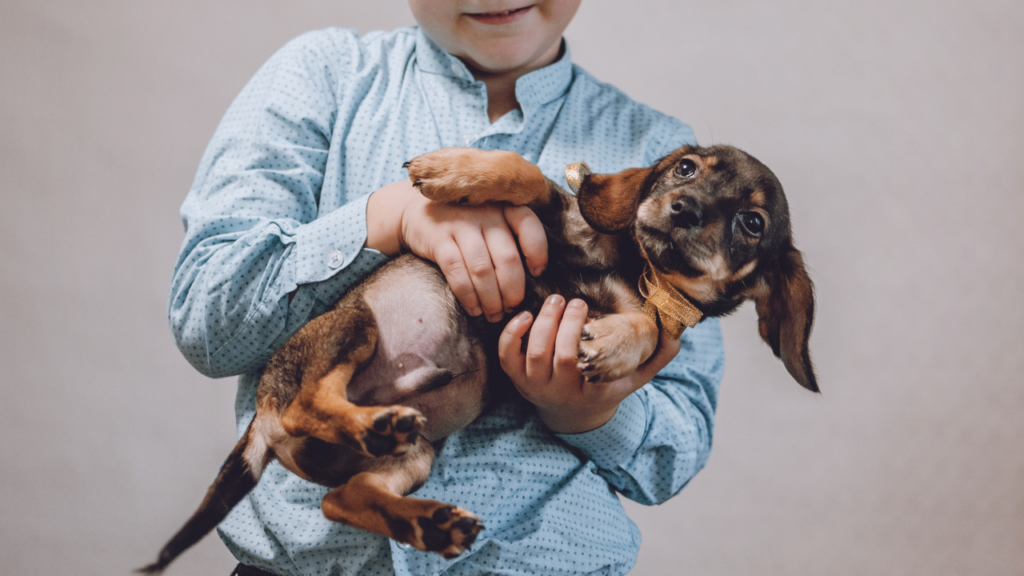
Choosing where your family dachshund comes from matters
For families with children, temperament matters even more than coat colour. A responsible breeder should:
- health test the puppy’s parents for IVDD and other genetic conditions,
- properly socialise puppies from birth with household sounds, children, and other animals,
- allow you to meet the puppy’s parents – temperament is strongly inherited,
- avoid sending puppies home too early – ideally not before 10 weeks of age.
Avoid buying from sellers who refuse visits, provide no documentation, or avoid conversations about health and temperament. Puppies from irresponsible breeding environments may develop unstable temperaments or hidden health problems – which creates even greater challenges in homes with children.
Final thoughts – is a dachshund a good family dog?
Yes – but not automatically.
A Dachshund can be an incredible family companion when raised by parents who understand the breed and teach children how to interact respectfully and safely. They need protection for their spine, opportunities to rest peacefully, and consistent guidance from the adults around them.
If you provide that, a Dachshund will reward your family with years of loyalty, funny evenings on the sofa, and the kind of warmth only a deeply bonded dog can bring. Children who grow up with Dachshunds often learn empathy, responsibility, and respect for another living being – lessons that stay with them for life.
If you have both a Dachshund and children, share your experience in the comments. Everyday stories from owners are often the most valuable support for families still making this decision.
FAQ – Frequently asked questions
Is a Dachshund good with children?
Yes, Dachshunds can be wonderful companions for children, especially school-age children (6+). However, they require supervision and children must be taught how to handle them safely – especially when it comes to protecting their spine.
What age child is best suited for a Dachshund?
There is no strict age limit, but families with children under 3 – 4 years old should be especially cautious. Younger children do not yet understand dog body language or safe handling rules. Adult supervision is essential.
Are Dachshunds aggressive toward children?
Dachshunds are not naturally aggressive dogs, but they are assertive and communicate discomfort quickly through growling or warning signals. This usually means the dog feels stressed, overwhelmed, or unsafe. Proper socialisation and teaching children respectful behaviour prevent most problems.
Is a miniature Dachshund better for families than a standard Dachshund?
Not necessarily. Miniature Dachshunds are more physically delicate and often better suited to families with older children. Standard Dachshunds tend to cope better in busy households. Temperament and early socialisation matter more than size alone.
How should you hold a Dachshund safely?
Always lift a Dachshund with two hands – one supporting the chest behind the front legs and the other supporting the hindquarters. Never lift them by the middle of the body and never encourage jumping from high surfaces.
Can a Dachshund live in a flat with children?
Absolutely. Dachshunds adapt very well to apartment living. They need regular walks, scent enrichment, and close family connection – all of which can be provided both in flats and in houses with gardens.
How much does a Dachshund puppy cost and is a pedigree puppy worth it for families with children?
For families with children, choosing a puppy from a responsible breeder is especially important because temperament and health are more predictable. The price of a pedigree Dachshund puppy typically ranges depending on variety, breeder reputation, and location. For many families, it is an investment in the long-term wellbeing and safety of both the dog and the household.


0 Comments