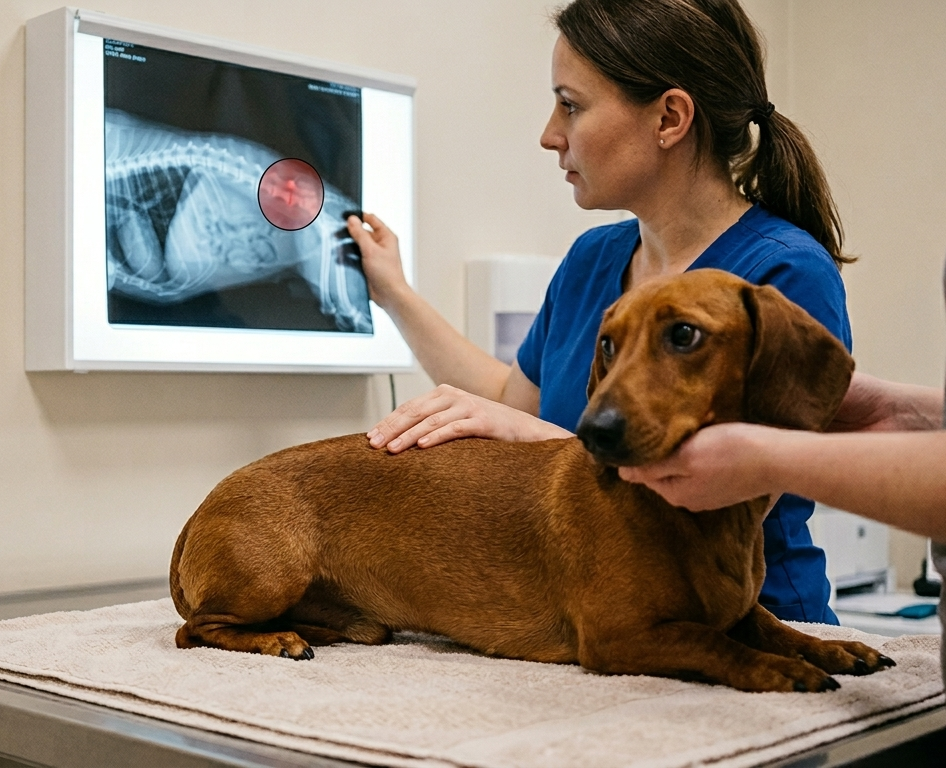
Why every dachshund owner needs to understand IVDD
Intervertebral Disc Disease (IVDD), commonly called disc disease or a slipped disc, is one of the most serious health conditions affecting Dachshunds. Studies estimate that up to 25% of Dachshunds will experience some form of IVDD during their lifetime, making it one of the breed’s biggest health risks.
That sounds frightening — but there’s also good news.
With early recognition, fast veterinary care, proper rehabilitation, and smart lifestyle management, many Dachshunds recover well and continue living happy, active lives.
Because of their unique body structure — long spine, short legs, and chondrodystrophic genetics — Dachshunds are especially vulnerable to spinal disc degeneration. A movement that might barely affect another breed can sometimes cause severe spinal injury in a Dachshund.
In this guide, you’ll learn:
- what IVDD actually is,
- early warning signs many owners miss,
- the stages of IVDD,
- treatment options and recovery expectations,
- how to reduce the risk of recurrence,
- and how to create a safer home for a Dachshund with back problems.
Important: This article is for educational purposes only. If your Dachshund shows neurological symptoms, sudden pain, weakness, or paralysis, contact a veterinary neurologist immediately.
What is IVDD in dachshunds?
IVDD (Intervertebral Disc Disease) is a degenerative spinal condition where the discs between the vertebrae lose flexibility, harden, and eventually rupture or herniate.
These discs normally act like soft shock absorbers for the spine. In Dachshunds, however, the discs often begin degenerating unusually early due to inherited chondrodystrophy.
The most common form seen in Dachshunds is Hansen Type I IVDD — a sudden disc extrusion.
This happens when the inner disc material bursts into the spinal canal and compresses the spinal cord. Depending on the severity of the compression, this can cause:
- severe pain,
- loss of coordination,
- weakness,
- paralysis,
- loss of bladder control,
- and in severe cases, permanent neurological damage.
This is why some owners say their Dachshund “stopped walking overnight.”
A simple way to understand IVDD
Imagine the spinal disc as a jelly-filled cushion.
In a healthy dog, the cushion stays soft and flexible.
In many Dachshunds, the cushion gradually hardens over time — almost like wet cement drying inside it.
When that hardened disc suddenly cracks, the material pushes against the spinal cord.
And the spinal cord is the body’s communication highway. It controls:
- movement,
- sensation,
- coordination,
- bladder function,
- and muscle control.
That’s why IVDD symptoms can escalate so quickly.
When does IVDD usually start?
Research suggests disc degeneration in Dachshunds may begin as early as 6–12 months of age, although clinical symptoms most commonly appear between ages 3 and 7.
The 5 stages of IVDD in dachshunds
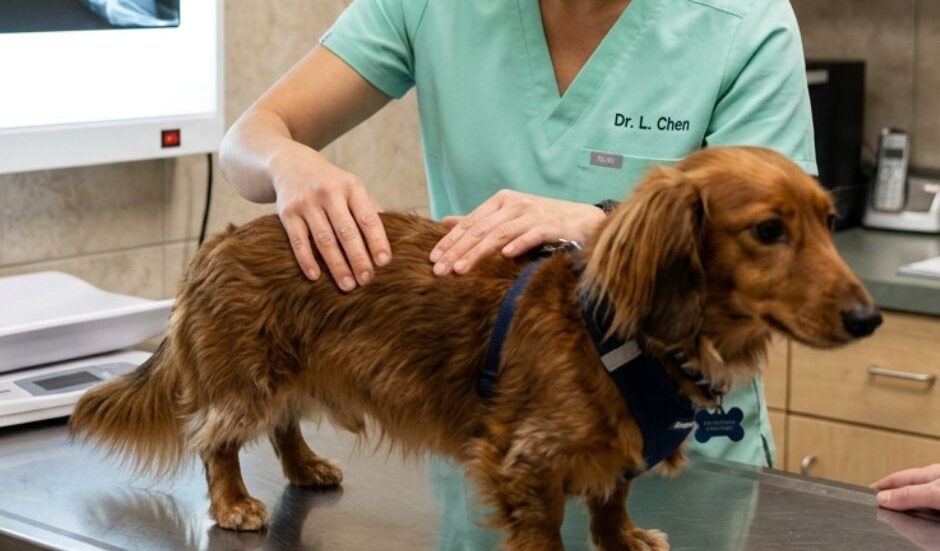
Veterinary neurologists commonly classify IVDD into five neurological grades. These stages help determine treatment and prognosis.
| Grade | Symptoms | Typical Treatment | Prognosis |
|---|---|---|---|
| Grade I | Pain only, no neurological deficits | Strict crate rest, anti-inflammatory medication, pain relief | Excellent |
| Grade II | Wobbly gait, mild weakness, rear-leg instability | Conservative treatment, rest, rehab | Good |
| Grade III | Dog cannot stand independently | Usually surgery + rehabilitation | Very good with rapid treatment |
| Grade IV | Paralysis but deep pain sensation still present | Emergency surgery + intensive rehab | Good to very good if treated quickly |
| Grade V | Paralysis with loss of deep pain sensation | Immediate surgery required | Variable — timing is critical |
The presence or absence of deep pain sensation is one of the most important factors affecting recovery chances.
Early signs of IVDD many owners miss
IVDD does not always begin dramatically. Sometimes the first symptoms are subtle and easy to dismiss.
Common Early Symptoms
- Reluctance to jump: Your Dachshund suddenly hesitates before jumping onto the sofa or bed. This is often one of the earliest signs of spinal discomfort.
- Walking carefully or “tip-toeing”: Dogs may move cautiously to reduce pressure on a painful part of the spine.
- Arched back: A slightly hunched posture is a common pain response. A slightly hunched posture is a common pain response.
- Reduced interest in play: Activities your dog once loved may suddenly seem uncomfortable.
- Crying out when picked up: Lifting can place pressure on the spine and trigger sharp pain.
Many owners initially think: “Maybe he just pulled a muscle.”
But these can be early warning signs of IVDD.
Neurological symptoms you should never ignore
As spinal cord compression worsens, neurological symptoms of IVDD can appear.
Warning signs include:
- wobbling or stumbling,
- crossing the rear legs,
- loss of coordination,
- dragging paws,
- weak hind legs,
- difficulty standing,
- loss of balance,
- shaking or trembling from pain.
These symptoms mean the spinal cord is being affected.
Emergency IVDD symptoms
Seek immediate veterinary attention if your Dachshund develops:
- inability to stand,
- paralysis,
- loss of bladder control,
- inability to urinate,
- loss of deep pain sensation,
- severe uncontrolled pain.
In IVDD cases, time matters enormously.
The faster spinal compression is treated, the better the chances of recovery.
What an IVDD episode often looks like
- Day 1: Something feels off – Your Dachshund avoids jumping, walks stiffly, or seems unusually quiet.
- Day 2: Symptoms worsen – Pain becomes more obvious. Rear legs may appear unstable or “floaty.”
- Day 3: Veterinary diagnosis – A neurological exam is performed, followed by imaging such as MRI or CT.
- Day 4: Treatment begins – Mild cases may begin strict conservative management. Moderate to severe cases often require surgery.
- Weeks 1–2: Early recovery – Pain starts improving. Some dogs regain strength and coordination quickly.
- Weeks 3–6: Rehabilitation Phase – Physical therapy focuses on rebuilding strength, coordination, and spinal stability.
- Months 2–3: Long-Term Recovery – Many Dachshunds regain excellent quality of life with proper treatment and rehab.
Diagnosing IVDD in dachshunds
X-Rays (Radiographs)
X-rays can help rule out fractures or other spinal abnormalities, but they cannot directly show spinal cord compression. Calcified discs visible on X-rays only indicate increased IVDD risk — not necessarily the exact injured disc.
MRI (Magnetic Resonance Imaging)
MRI is currently considered the gold standard for diagnosing IVDD. It provides detailed information about:
- spinal cord compression,
- disc herniation,
- inflammation,
- and swelling.
CT Scan With Myelography
CT imaging is often used in surgical planning because it provides excellent detail of calcified disc material and bony structures.
Conservative treatment vs surgery
Conservative Treatment (Typically Grades I–II)
- Strict crate rest: This is essential. A healing disc needs complete stability to reduce further damage.
- Pain medication: Pain control helps improve comfort and reduces stress.
- Anti-Inflammatory medication: Used to decrease swelling around the spinal cord.
- Gabapentin: Often prescribed for nerve-related pain common in IVDD cases.
- Controlled rehabilitation: Once pain is under control, rehabilitation helps rebuild stability and muscle support.
Surgical Treatment (Typically Grades III–V)
- Hemilaminectomy – The most common IVDD surgery in Dachshunds. Part of the vertebral bone is removed to relieve pressure on the spinal cord.
- Disc material removal – The herniated disc material compressing the spinal cord is removed.
- Hospitalization – Most dogs remain hospitalized for monitoring and pain management after surgery.
Rehabilitation After IVDD
Rehabilitation is not optional — it is a crucial part of recovery. Modern IVDD rehab programs may include:
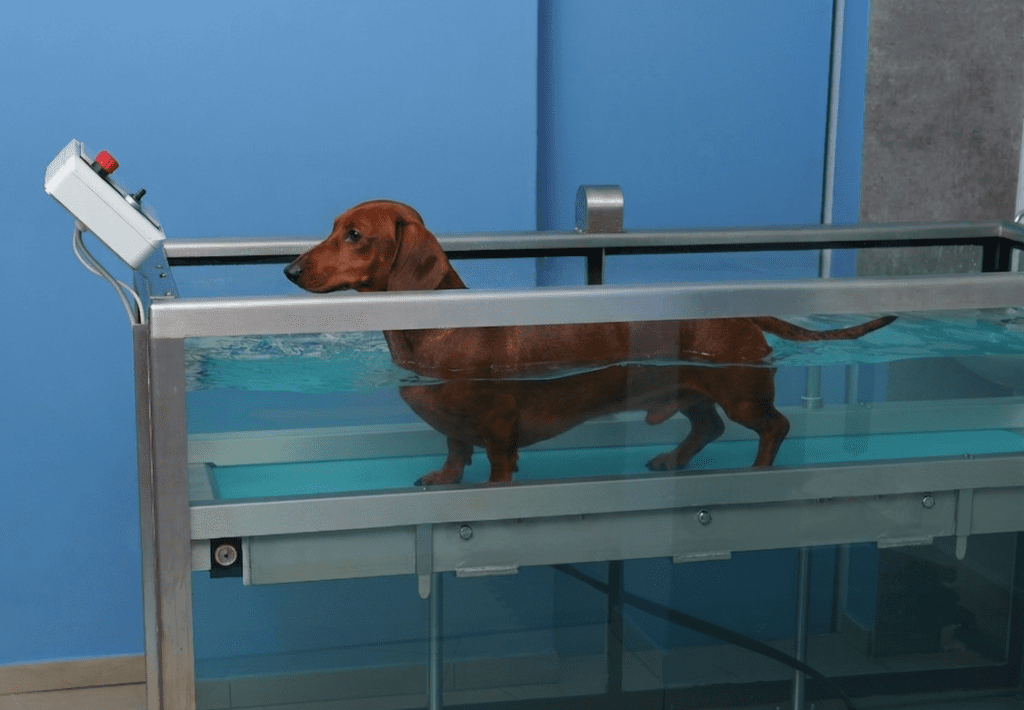
- Underwater treadmill therapy: Builds muscle strength without placing full weight on the spine.
- Laser therapy: Can help reduce pain and support tissue healing
- Physiotherapy exercises: Improve coordination, strength, and mobility.
- Proprioception training: Helps dogs relearn body awareness and balance.
- Muscle strengthening: Strong core and spinal-support muscles help protect the back long-term.
How to prevent IVDD in dachshunds
While IVDD cannot always be prevented, lifestyle changes can significantly reduce risk.
Keep Your Dachshund Lean
Excess weight places enormous strain on the spine. You should be able to easily feel your dog’s ribs without pressing hard.
Use Ramps Instead of Allowing Jumping
Repeated jumping on and off furniture is one of the biggest spinal risks for Dachshunds.
Install ramps for:
- sofas,
- beds,
- and other elevated surfaces.
Choose a Proper Harness
A well-fitted Y-shaped or guard-style harness distributes pressure more safely than a collar.
Build Strong Supporting Muscles
Regular controlled exercise helps stabilize the spine. The best activities include:
- calm walks,
- walking on grass or forest trails,
- gentle strength-building exercises.
Avoid excessive ball chasing or high-impact activities.
How to prepare your home for a dachshund with IVDD
- Orthopedic dog bed – Provides spinal support and improves comfort during recovery.
- Non-slip rugs and mats – Slippery floors increase the risk of falls and re-injury.
- Raised food and water bowls – Can reduce strain on the neck and upper spine.
- Furniture ramps – Essential for preventing jumping.
- Restricted recovery space – Limiting movement prevents sudden twisting or running during healing.
- Avoid stairs – Repeated stair climbing places heavy stress on the spine.
Common mistakes dachshund owners make
- Returning to normal activity too soon: Dogs often seem better before the spine has fully healed.
- Allowing jumping again: Even a single bad jump can trigger another episode.
- Skipping rehabilitation: Recovery is often slower and less stable without proper rehab.
- Poor weight management: Extra weight dramatically increases spinal stress.
- Overexercising during recovery: Long walks too early can overload healing tissues.
- Lifting incorrectly: Always support both the chest and rear end when carrying a Dachshund.
FAQ: Frequently asked questions about IVDD in dachshunds
Can a Dachshund Walk Again After Paralysis?
Yes — many can. With rapid surgery and intensive rehabilitation, even some dogs with severe paralysis can regain mobility. Some dogs develop what’s known as a “spinal walk,” while others recover near-normal movement.
How Much Does IVDD Surgery Cost?
Costs vary widely depending on country, clinic, diagnostics, and case severity. MRI imaging and surgery are typically the largest expenses.
Do Supplements Prevent IVDD?
Joint supplements may support overall mobility and joint health, but they cannot reverse the genetic spinal structure associated with Dachshunds. Weight control and avoiding jumping remain far more important.
Final Thoughts
IVDD is serious — but it is not always hopeless.
The keys to giving your Dachshund the best possible outcome are:
- recognizing symptoms early,
- acting quickly,
- getting proper neurological evaluation,
- following treatment recommendations carefully,
- committing to rehabilitation,
- and focusing on long-term prevention.
With informed care and lifestyle adjustments, many Dachshunds live long, active, joyful lives — even after an IVDD episode.
0 Comments