
The Dachshund’s Character: A Complete Guide
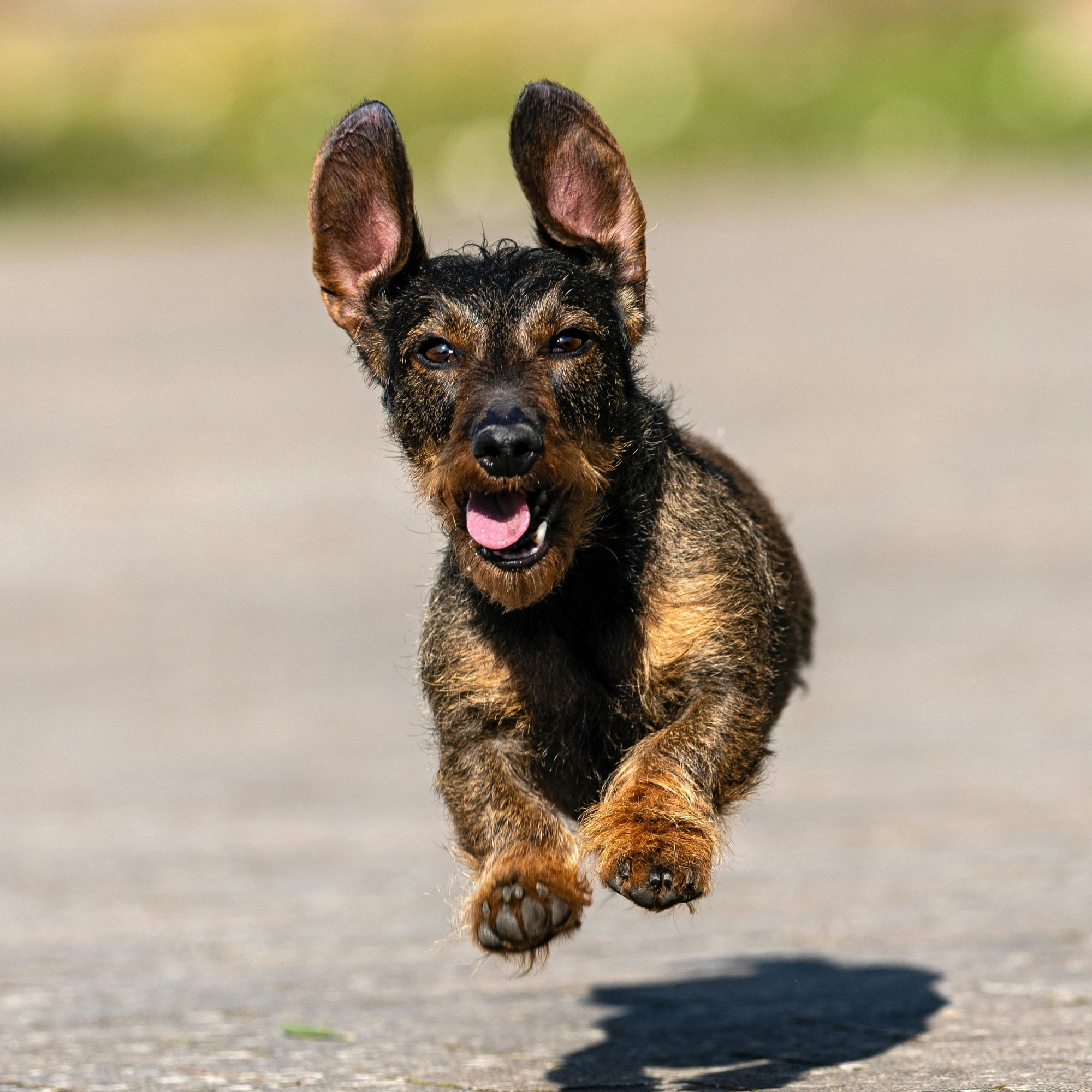
The Dachshund is a breed full of surprises. This small dog with its elongated body hides a personality full of contradictions — a loving companion at home and a relentless hunter at the same time. To truly understand your Dachshund, it’s worth getting to know its character from the inside out: where it comes from, what drives it, and what it truly needs.
This guide is a map to the Dachshund’s temperament — for those who are just considering adoption, and for those who have been living with a Dachshund for years.
The Dachshund — Character and Temperament
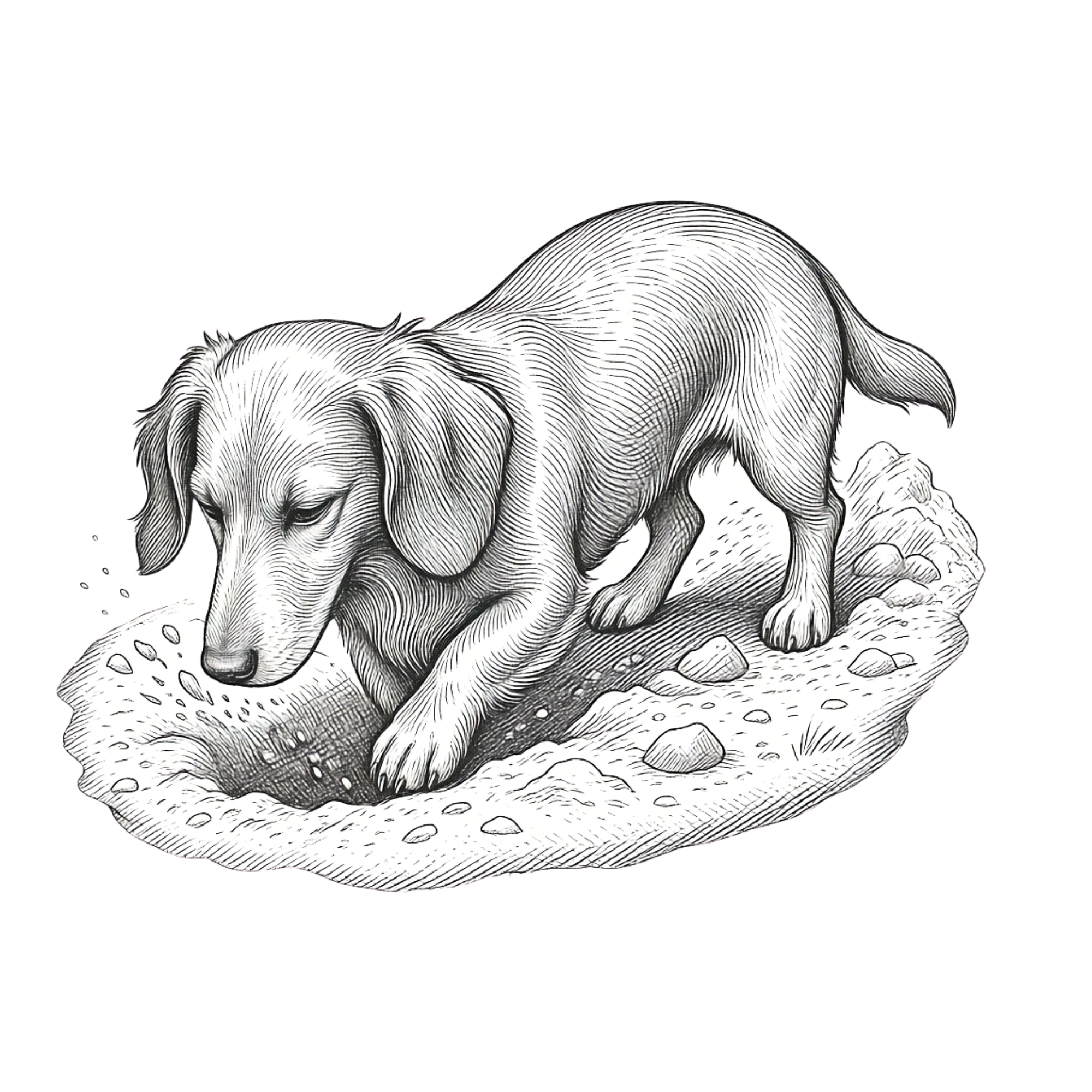
For centuries, Dachshunds worked as burrow hunting dogs. They went underground, tracked game, and operated far from human sight — independently, bravely, and with determination. These traits are still present in Dachshunds today, regardless of whether the dog lives in an apartment or a house with a garden.
The Three Pillars of the Dachshund’s Character
- Courage — a Dachshund is not afraid of dogs much larger than itself and naturally defends its space.
- Independence — it thinks for itself, evaluates situations, and acts according to its own judgment.
- Loyalty — it forms a strong bond with its person and is capable of loving with its whole heart.
Dachshund Intelligence
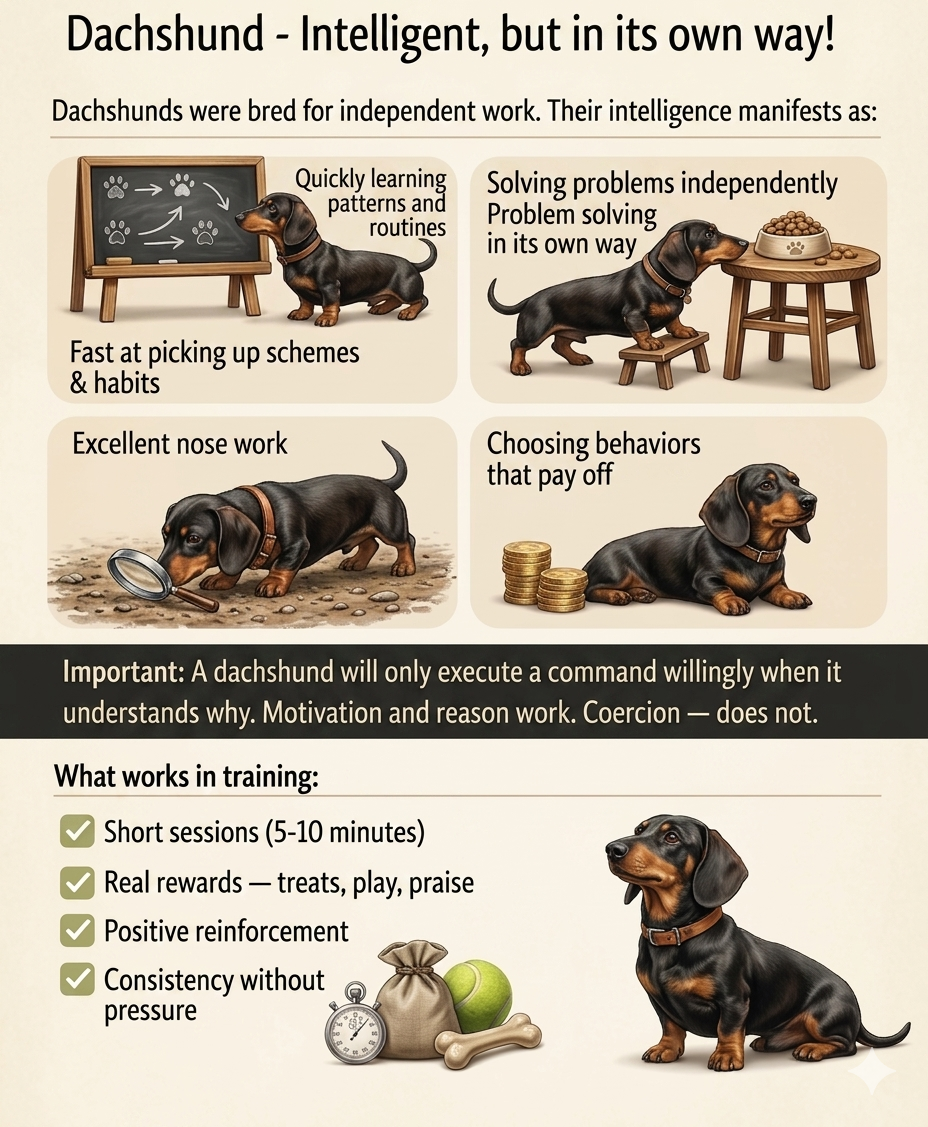
The Dachshund is intelligent — but in a different way than breeds developed to work closely with humans. This is a dog bred for independent work. That’s why its intelligence shows itself through:
- quickly learning patterns and routines
- solving problems in its own way
- excellent scent-tracking abilities
- choosing behaviors that benefit it
Important: A Dachshund will willingly follow commands when it understands the purpose behind them. Motivation and meaning work. Force does not.
What works well in training:
✅ short sessions (5–10 minutes)
✅ meaningful rewards — treats, play, praise
✅ positive reinforcement
✅ consistency without pressure
Check out the guide: Training a Dachshund
Where Does a Dachshund’s Stubbornness Come From?
A Dachshund’s stubbornness is probably the most talked-about trait of the breed — and one of the most misunderstood. It is not spitefulness. It is determination, intentionally reinforced over generations. A dog that backed out of a burrow was not suited for the job.
In practice, this means that a Dachshund:
- does not always listen immediately
- likes to do things its own way
- tests boundaries — especially when rules are inconsistent
- will not give up easily when it really wants something
How to Work with a Stubborn Dachshund
✅ clear and consistent rules from day one
✅ calmness and patience
✅ short training sessions ending with success
✅ ignoring unwanted behaviors instead of punishing them
❌ shouting and pressure — they have the opposite effect
❌ inconsistent rules — a Dachshund will notice and use them immediately
Hunting Instinct
No matter how much of a “couch dog” a Dachshund may be at home, its hunting instinct will always remain part of its nature. You cannot train it away completely — and it is not worth trying.
How the Hunting Instinct Shows Itself
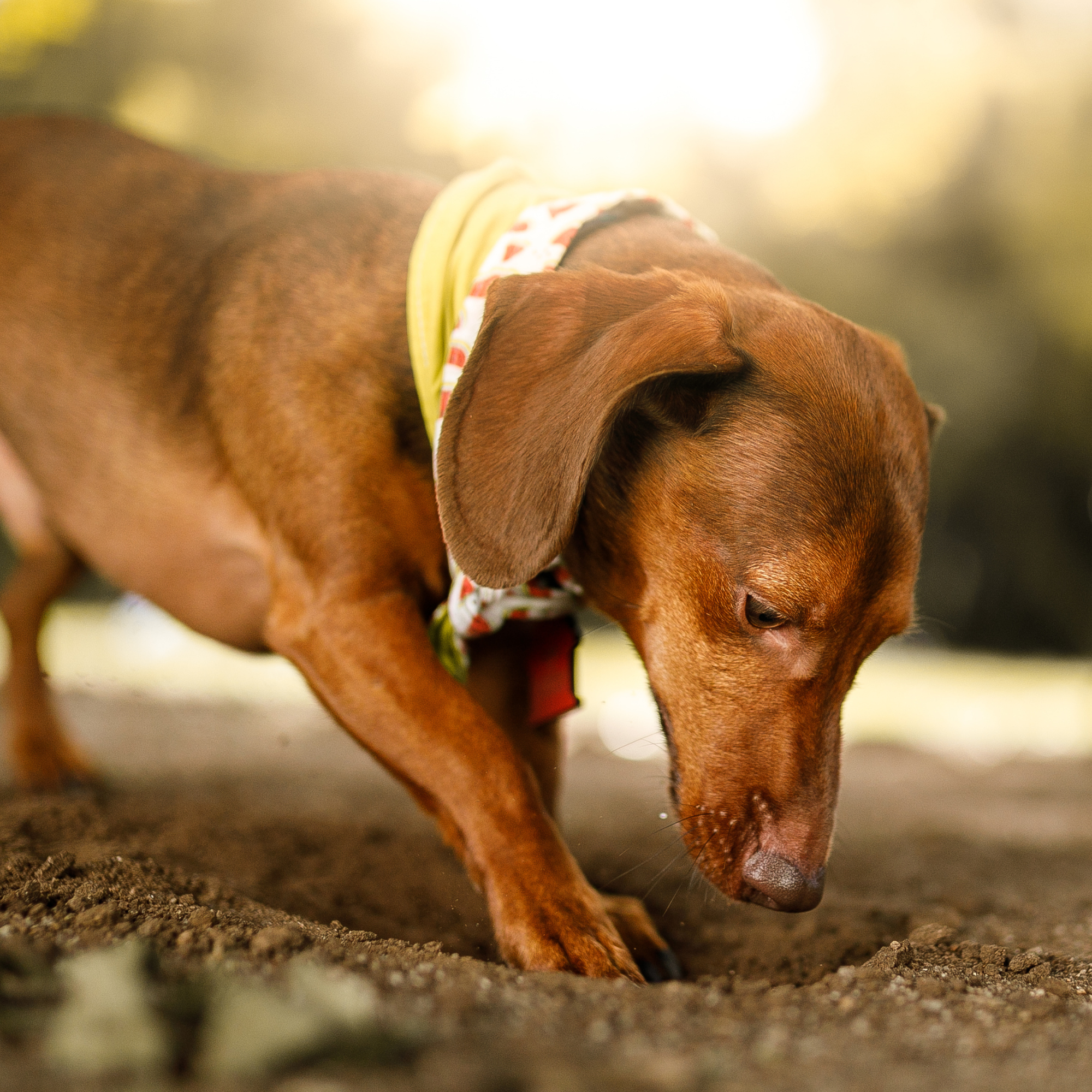
- nose glued to the ground on every walk
- chasing cats, birds, and squirrels
- digging holes in the garden with full commitment
- investigating every scent along the way
How to Satisfy It in a Healthy Way
✅ scent games and snuffle mats
✅ nosework and tracking activities
✅ walks on a long leash
✅ puzzle toys and a food-filled Kong

The Emotional Side of a Dachshund
Dachshunds are highly emotional dogs. They form very strong bonds with their owners, quickly sense the mood at home, and do not cope well with long periods of loneliness.
Signs That a Dachshund Needs More Attention
- loud howling or barking after the owner leaves
- destroying objects during absences
- excessive licking or scratching at doors
- apathy or loss of appetite
Dachshunds with Children and Other Animals
Dachshunds can make wonderful family dogs — but building a good relationship with children requires effort from both sides and adult supervision, especially at the beginning.
A Dachshund does not like:
- sudden movements and loud shouting
- squeezing or pulling
- having its space disturbed while eating or resting
How to Build a Good Relationship
✅ teach children to recognize a dog’s calming signals
✅ give the Dachshund its own safe space
✅ always supervise interactions with small children
✅ socialize the Dachshund from puppyhood
Dachshunds usually get along well with other dogs. They can be somewhat territorial, but with proper introductions they are often able to live peacefully even with cats.
Energy Level and Needs
The Dachshund is an active dog that needs both physical exercise and mental stimulation.
An under-stimulated Dachshund may:
- 2–3 walks (about 45–60 minutes total)
- 1 session of scent-based or puzzle play
- regular contact and closeness with its human
An under-stimulated Dachshund may:
- destroy objects
- bark excessively
- become hyperactive or apathetic
- display compulsive behaviors
Dachshund Barking
Dachshunds are naturally alert and tend to respond to stimuli with their voice. This is a breed trait that can be managed — but never completely eliminated
A Dachshund barks when:
- it hears an unfamiliar sound behind the door
- it sees another animal through the window
- it feels excited or frustrated
- it wants to get its owner’s attention
How to Reduce Excessive Barking
✅teach the “quiet” command from puppyhood
✅ scent work to lower arousal levels
✅ routine and predictability throughout the day
✅ limiting triggers and stimuli (for example, window film)

Fun Facts About Dachshunds – What You May Not Know About Your Favorite Breed
If you’re ready to discover some fascinating facts about Dachshunds, this article is just for you! Do you already know everything about your furry companion? Or maybe you’ll find a few surprising facts here?
Read more…
Is a Dachshund the Right Dog for You?
A Dachshund may be the perfect match if you:
✅ value a close bond and a dog with a sense of humor
✅ have patience for consistent training
✅ enjoy activity and scent-based games
✅ don’t mind a dog with a strong personality
It’s worth reconsidering if you:
❌ are looking for an easy, always obedient dog
❌ leave your dog alone for many hours every day
❌ don’t have time for regular exercise and mental stimulation
❌ are bothered by barking
Frequently Asked Questions
Are Dachshunds difficult to train?
Dachshunds are intelligent but independent — which can make them seem difficult. With the right approach (short training sessions, positive reinforcement, and real motivation), they learn very effectively.
Are Dachshunds suitable for first-time owners?
They can be a great dog for a first-time owner — if the person understands the nature of the breed and is ready for consistent training. A Dachshund quickly detects inconsistency in rules.
Do Dachshunds bark a lot?
Yes, Dachshunds are naturally alert and tend to respond vocally to stimuli. This is a breed trait that can be managed, but it cannot be completely eliminated.
Is a Dachshund a family dog?
Yes, with proper socialization and teaching respect on the child’s side. Adult supervision is essential, especially with small children.
Are Dachshunds aggressive?

Rabbit Dachshund: size, weight, temperament, health & care guide
The Rabbit Dachshund, also known as the Kaninchen Dachshund, is the smallest Dachshund variety recognized by the Fédération Cynologique...

Why are Dachshunds called Doxies?
Spend some time around dachshund owners, and you’ll hear the word ‘Doxie’ for sure. It’s the go-to term for owners, breeders, and social media...

Miniature vs Standard Dachshund: Which One Is Right for You?
If you’ve fallen in love with that long body and curious face (who hasn’t?), the next big question is:Should you choose a miniature or a standard...