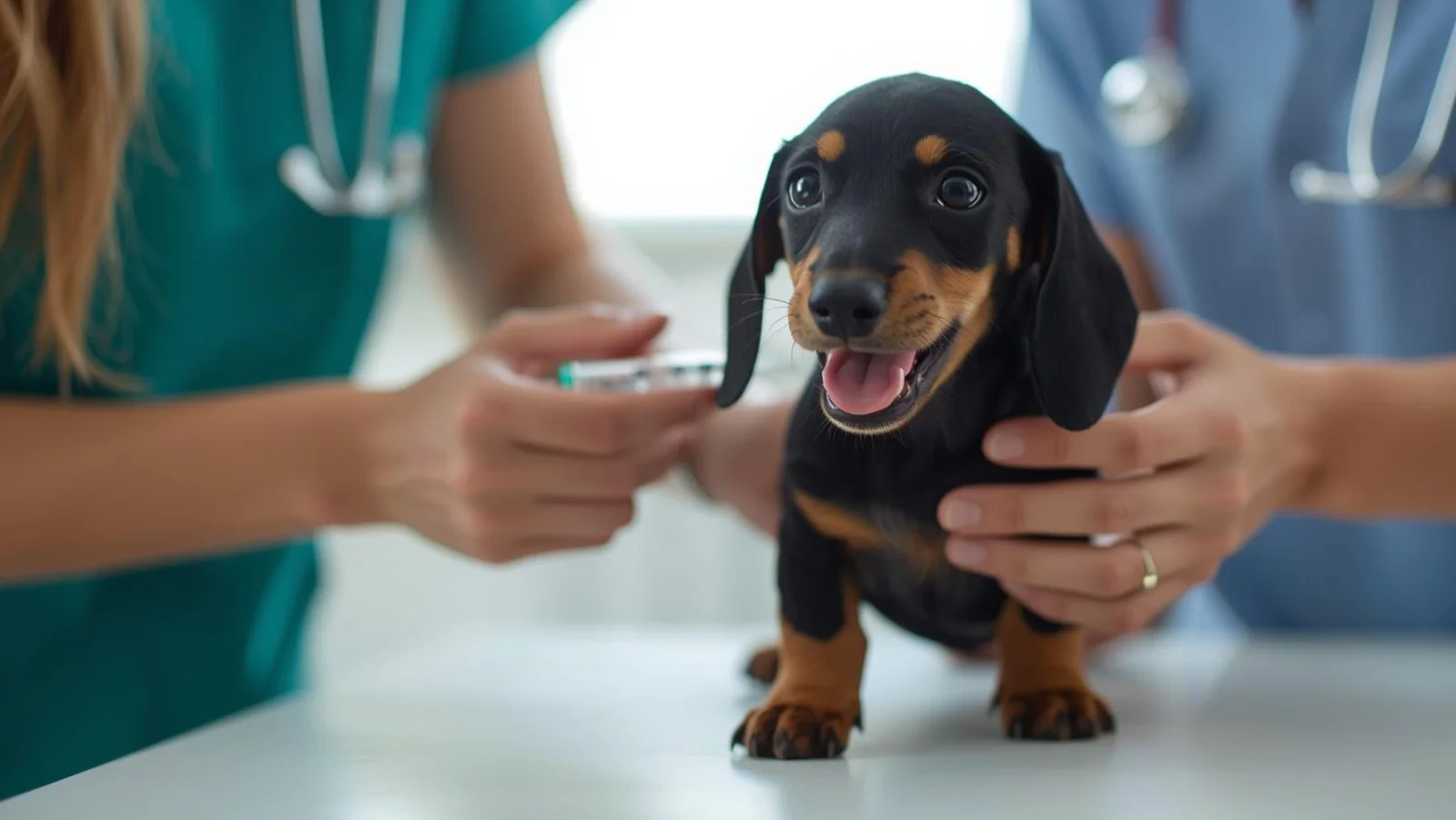
Bringing home a Dachshund puppy means tiny paws, enormous personality, and approximately 47 questions about whether they’re allowed to do anything yet.
Can they go outside? Can they meet the neighbor’s dog? When do they get their first shots? And why does the puppy vaccination schedule seem to involve so many vet visits?
The good news: once you understand what the vaccines are for and when they’re usually given, the whole process makes much more sense.
Most puppies start their core vaccinations at 6–8 weeks of age, with additional doses given every 2–4 weeks until at least 16 weeks old. The exact schedule can vary depending on your puppy’s health, vaccination history, local disease risk and your veterinarian’s recommendations.
Here’s everything a new Dachshund parent needs to know about puppy vaccinations in the US — including first shots, rabies, leptospirosis, when it’s safe to go for walks, vaccine side effects and what you can expect to pay.
Important: This article is for general education, not a substitute for veterinary care. Your veterinarian should create your puppy’s individual vaccination plan.
Dachshund puppy vaccination schedule at a glance
Here’s the simple version.
| Puppy age | What usually happens |
|---|---|
| 6–8 weeks | First core puppy vaccination |
| 9–12 weeks | Next core vaccination, usually 2–4 weeks after the first |
| 12+ weeks | Leptospirosis vaccination may begin; rabies may be due depending on local requirements and vaccine labeling |
| 14–16+ weeks | Final core puppy vaccination |
| Around 6 months | Your veterinarian may recommend revaccination or antibody testing depending on the protocol |
| Around 1 year | Booster and wellness visit |
| Adult | Ongoing vaccinations based on vaccine type, lifestyle, risk and local law |
The important bit is that the final core puppy vaccination should be given at 16 weeks of age or older under current WSAVA guidance. Puppies in higher-risk situations may have a schedule that extends further.
This is a framework, not a prescription. Your puppy’s vet may adjust the timing based on previous vaccines, the products being used and what’s happening in your area.
When should a Dachshund puppy get their first shots?
Most puppies receive their first core vaccines at 6–8 weeks of age.
The first vaccination usually protects against some of the most serious and contagious diseases puppies can encounter, including:
- Canine distemper
- Canine parvovirus
- Canine adenovirus
These are considered core vaccines and are recommended for dogs regardless of geographical location.
If you’re bringing home a puppy from a breeder or rescue, ask for their vaccination record. It should tell you:
- Which vaccine was given
- The date it was administered
- The vaccine manufacturer/product, if recorded
- When the next dose is due
Take that paperwork to your first vet appointment. And if your puppy doesn’t have a vaccination record? Don’t panic. Your veterinarian can work out an appropriate catch-up plan.
Why does my puppy need so many vaccinations?
This is one of the most confusing parts of the whole process. If your puppy had a vaccine at eight weeks, why do they need another one at 11 or 12 weeks? The answer is maternal antibodies.
Puppies receive antibodies from their mother, particularly through colostrum shortly after birth. These antibodies help protect them during their early weeks of life. The catch? They can also interfere with the puppy’s response to vaccination.
That means there’s a period when a puppy may have maternal antibodies that are protective but not strong enough to reliably prevent infection – while also potentially reducing the effectiveness of a vaccine. That’s why puppy vaccinations are given as a series, rather than one giant puppy-sized injection of “everything.”
Current WSAVA guidance recommends core puppy vaccines every 2–4 weeks, with the final dose at 16 weeks of age or older.
The big takeaway
Your puppy isn’t considered fully protected simply because they’ve had their first shot. The series matters.
What vaccines does a Dachshund puppy need?
Not every puppy receives the same list of vaccines. Some are considered core vaccines, while others depend on your puppy’s lifestyle, location and exposure risk.
| Vaccine | What it protects against | Typical US recommendation |
|---|---|---|
| Distemper | Canine distemper | Core |
| Adenovirus | Infectious canine hepatitis and related disease | Core |
| Parvovirus | Canine parvovirus | Core |
| Leptospirosis | Serious bacterial infection | Core under current AAHA guidance |
| Rabies | Rabies | Required according to applicable local/state law |
| Bordetella | Part of canine infectious respiratory disease complex | Lifestyle/risk based |
| Canine influenza | Dog flu | Lifestyle/location based |
| Lyme disease | Lyme disease | Geography/exposure based |
AAHA’s canine vaccination guidelines were updated in 2024 to include leptospirosis as a core vaccine recommendation for dogs in North America. That last point is worth paying attention to because you may still find older articles online calling leptospirosis an “optional” vaccine.
What is the DHPP or DAPP vaccine?
If you’ve looked at your puppy’s vaccination paperwork and thought, “What on earth is DA2PP?”, you’re not alone.
DHPP, DAPP and DA2PP are names used for combination vaccines that protect against several canine diseases.
Depending on the specific product, the letters can refer to:
- D = Distemper
- H/A = Hepatitis/adenovirus
- P = Parvovirus
- P = Parainfluenza
The exact combination varies between products, so don’t worry about memorizing the alphabet soup. Your puppy’s vaccination record is the important bit.
Does my Dachshund puppy need the Leptospirosis vaccine?
Current AAHA guidance considers leptospirosis a core vaccine for dogs in North America.
Leptospirosis is a bacterial disease that can cause serious illness and can also infect people. Dogs can encounter the bacteria in contaminated water, soil and environments where infected wildlife or rodents have been.
And no, this isn’t only a “farm dog” problem.
Leptospirosis can occur in:
- Urban areas
- Suburban neighborhoods
- Rural areas
- Yards
- Parks
- Areas with standing water
- Places where rodents or wildlife are present
AAHA’s updated guidance recommends leptospirosis vaccination for dogs starting at 12 weeks of age, regardless of breed, sex or lifestyle, with an initial two-dose series followed by annual vaccination.
So your miniature Dachshund who spends most of their time investigating puddles in the backyard isn’t necessarily “low risk.”
If your veterinarian recommends leptospirosis vaccination, there’s a good reason.
When does a puppy get the Rabies vaccine?
In the US, rabies vaccination timing is influenced by state and local laws as well as the vaccine product being used. Many puppies receive their first rabies vaccine at around 12–16 weeks of age.
The CDC advises that dogs should be vaccinated for rabies according to local laws, and US federal dog-importation rules recognize an initial rabies vaccination given at 12 weeks (84 days) or older.
Your veterinarian can tell you exactly when your Dachshund’s rabies vaccine is due and what your state requires.
One important distinction
Rabies vaccination is not just another lifestyle vaccine you can casually skip. Rabies is a serious, fatal disease that can affect both animals and people, and vaccination requirements exist for an important reason.
Keep your dog’s rabies certificate somewhere safe – you’ll likely need it for things such as travel, boarding or certain licensing requirements.

Can my Dachshund puppy go outside before all their shots?
Yes — but not every outdoor environment is equally safe. This is one of those pieces of puppy advice that has become unnecessarily black and white.
You may have heard: “Don’t let your puppy touch the ground until they’re fully vaccinated.”
But keeping a puppy completely isolated for months isn’t ideal either. Puppies have an important socialization period, and WSAVA supports appropriate socialization before the puppy vaccination series is complete, while taking infectious disease risk into account.
Safer ways to socialize your puppy
Before the vaccination series is complete, you can often:
- Carry your puppy outside
- Let them explore your own yard
- Take them for car rides
- Introduce them to different household sounds
- Let them meet healthy, vaccinated dogs you know
- Attend a well-managed puppy socialization class
- Let them experience different surfaces and environments
- Invite trusted people to your home
Places to be more cautious
Avoid or discuss with your veterinarian:
- Dog parks
- Areas heavily used by unknown dogs
- Dog-heavy communal areas
- Places contaminated with dog feces
- Unknown or unvaccinated dogs
- Standing water or areas with potential wildlife/rodent contamination
Your vet can help you judge the risk in your specific area.
When can my Dachshund puppy go on walks?
This is where things get a little more nuanced than “wait X days.” The right time for normal walks depends on your puppy’s vaccination status, local disease risk and your veterinarian’s advice.
A puppy who lives in an area with a high risk of parvovirus may need a different approach from a puppy in a lower-risk environment. And a quiet neighborhood sidewalk isn’t necessarily the same risk as a busy dog park. While you’re waiting for your vet’s green light for normal walks, you can still work on some seriously important skills:
- Wearing a harness
- Walking beside you
- Looking at you when called
- Getting used to traffic
- Meeting people
- Hearing bikes and other noises
- Exploring new surfaces
- Learning that the world is not, in fact, terrifying
Your future Dachshund-walking self will thank you.
How much do puppy vaccinations cost in the US?
Here’s where things get frustrating: there isn’t one national price for puppy vaccinations.
The cost depends on your location, the veterinary practice, which vaccines your puppy needs and whether the clinic charges an examination fee at each visit.
Current 2026 US pricing data puts individual dog vaccines broadly in the $20–$60+ range, while a complete puppy vaccination series can range from around $200 to $500 or more, depending on the clinic and what’s included. Low-cost vaccination clinics may charge substantially less.
Approximate 2026 US price ranges
| Vaccine/care | Approximate US cost |
|---|---|
| DHPP/DAPP | $20–$60 per dose |
| Rabies | $15–$60 |
| Leptospirosis | $25–$60+ |
| Bordetella | $20–$60 |
| Lyme | $30–$65+ |
| Canine influenza | $30–$65+ |
| Puppy vaccination series | About $200–$500+ |
| Veterinary exam | Often $40–$150+ per visit |
These are planning estimates, not fixed national prices. A private veterinary practice in a major city can charge considerably more than a nonprofit or municipal vaccination clinic.
For example, published 2026 prices from individual clinics show DHPP doses around $30–$45, while some low-cost clinics charge less.
Why does the bill add up so quickly?
Because you’re not necessarily paying for “a shot.” A puppy’s visit may include:
- Physical examination
- Vaccine
- Deworming
- Fecal testing
- Parasite prevention
- Microchipping
- Other puppy wellness care
And you’ll usually have several visits. Before your appointment, ask: “Can you give me an estimate for my puppy’s complete vaccination series, including exam fees?”. That makes budgeting much easier.
Are puppy vaccines safe?
Vaccines are an important part of preventive healthcare, but like any medical treatment, they can cause side effects.
Common mild reactions
Your puppy may be:
- Sleepier than usual
- A little sore
- Less interested in food for a short time
- Mildly warm or tired
These reactions are generally temporary.
When should you call the vet?
Contact your veterinarian if you’re concerned about your puppy’s reaction or if symptoms seem severe or persistent.
Seek urgent veterinary care if your puppy develops signs such as:
- Difficulty breathing
- Collapse
- Severe facial swelling
- A serious or rapidly worsening reaction
AAHA provides specific guidance on recognizing and managing vaccine reactions.
And don’t be afraid to ask your vet what reactions are normal before you leave the clinic. It’s much easier than frantically Googling “is my puppy dying?” at 11 p.m.
What if my puppy misses a vaccine?
First: don’t panic. Call your veterinarian rather than trying to work out a new schedule yourself.
Take your puppy’s vaccination records with you so the vet can see:
- Which vaccines were given
- When they were given
- Which doses are missing
- How old your puppy is now
AAHA guidance notes that when vaccination history is unknown or vaccines are overdue, the benefits of vaccinating generally outweigh the risks in most cases.
Your vet can determine whether your puppy needs another dose, a catch-up schedule or additional protection.
What should I bring to my puppy’s first vaccination appointment?
Your first puppy vet visit is about more than getting a needle in a tiny leg.
Bring:
- Vaccination records
- Breeder or rescue paperwork
- Adoption paperwork
- A list of medications or supplements
- Any health questions you’ve noticed
- A stool sample if your veterinarian requests one
- A few tasty treats
And because this is a Dachshund, it’s also a good time to ask about:
- Healthy puppy weight
- Feeding amounts
- Safe exercise
- Parasite prevention
- Socialization
- Back-friendly handling
- When your puppy can start normal walks
You don’t need to arrive with a 14-page list of questions. Although, let’s be honest, if you do, your veterinarian has definitely met a new puppy owner before.

Your Dachshund puppy vaccination checklist
Before the first vaccine
☐ Find a veterinarian
☐ Get your puppy’s vaccination records
☐ Ask which vaccines your vet recommends
☐ Ask when the next dose is due
☐ Discuss parasite prevention
☐ Ask about leptospirosis
☐ Ask when rabies vaccination is required
At every vaccination visit
☐ Bring vaccination records
☐ Ask which vaccines were given
☐ Book the next appointment
☐ Ask what side effects to expect
☐ Ask what activities are safe before the next dose
Before normal walks
☐ Complete the recommended puppy vaccine series
☐ Confirm your vet’s advice for your local area
☐ Make sure rabies requirements are met
☐ Start with lower-risk walking environments
☐ Keep socialization going safely
Dachshund puppy vaccination FAQ
When should a Dachshund puppy get their first shots?
Most puppies receive their first core vaccination at 6–8 weeks of age. Additional doses are generally given every 2–4 weeks, with the final core puppy dose at 16 weeks of age or older.
How many shots does a Dachshund puppy need?
There isn’t one fixed number for every puppy. The core vaccination series generally involves at least three doses given during puppyhood, with the final dose at 16 weeks or older. Additional vaccines, such as leptospirosis or Bordetella, follow their own schedules.
What vaccines does a Dachshund puppy need?
Core protection includes distemper, adenovirus, parvovirus and, under current AAHA guidance in North America, leptospirosis. Rabies vaccination is also required according to applicable state and local laws. Other vaccines may be recommended based on your puppy’s lifestyle and location.
Does my Dachshund puppy need the leptospirosis vaccine?
Current AAHA guidance recommends leptospirosis vaccination as a core vaccine for dogs in North America. It is recommended for dogs starting at 12 weeks of age, regardless of breed or lifestyle, because exposure can occur in urban, suburban and rural environments.
When does a puppy get the rabies vaccine?
Many puppies receive their first rabies vaccine at around 12–16 weeks, but requirements vary according to state and local law and the vaccine product. Check with your veterinarian for the schedule that applies where you live.
Can my puppy go outside before all vaccinations are complete?
Yes. Safe, controlled socialization can begin before the vaccination series is complete. However, puppies should avoid high-risk environments such as dog parks and areas heavily contaminated by unknown dogs. Ask your veterinarian about disease risk in your area.
When can my Dachshund puppy go for normal walks?
The timing depends on your puppy’s vaccination schedule and local disease risk. Your veterinarian can tell you when your puppy is adequately protected for normal walks and which environments are safest to start with.
How much do puppy vaccinations cost in the US?
A complete puppy vaccination series commonly costs around $200–$500 or more, although low-cost clinics may charge substantially less and private practices in expensive areas may charge more. Exam fees and additional vaccines can increase the total.
What are normal puppy vaccine side effects?
Mild tiredness, soreness, reduced appetite and a slight fever can occur after vaccination. Severe reactions such as difficulty breathing, collapse or significant facial swelling require urgent veterinary attention.
What happens if my puppy misses a vaccination?
Contact your veterinarian and bring your puppy’s vaccination records. Don’t restart or change the vaccination schedule yourself. Your vet can create an appropriate catch-up plan.
The bottom line: protect your puppy without putting life on hold
Those first few months with a Dachshund puppy can feel like one long checklist. Vaccination. Deworming. Socialization. Potty training. Chewing. More chewing. Why are they eating that?
But the puppy vaccine schedule is there for a good reason.
Start core vaccinations around 6–8 weeks, keep the series going every 2–4 weeks, and make sure the final core puppy vaccine is given at 16 weeks or older. Talk to your veterinarian about leptospirosis, rabies and any lifestyle vaccines your Dachshund may need.
And remember: protecting your puppy doesn’t mean keeping them in a bubble.
Safe, positive socialization can begin while they’re still completing their vaccinations. Your job is to find that sweet spot between protecting their little immune system and helping them discover that the world is a pretty great place.
Because your Dachshund has a lot of important business to attend to.
Mostly sniffing.
But still.


0 Comments