
Preparing for a dachshund puppy means puppy-proofing at floor level, setting up a crate before pickup day, sourcing a ramp to protect their spine, and having an enzymatic cleaner ready before the first accident happens – because it will.
Puppy-proofing your home
To puppy-proof for a dachshund, get down to floor level and remove every electrical cord, toxic substance, and gap in fencing a low, curious dog could reach, chew, or squeeze through. Dachshunds are ground-level explorers with zero self-preservation instinct.
Start by walking each room at baseboard height – literally crouch down. Electrical cords are the biggest immediate hazard; tuck them away or use cable management sleeves. Trash cans need lids. Cleaning products, chocolate, xylitol-containing foods (gum, peanut butter, some supplements), grapes, raisins, and onions all need to be genuinely out of reach – not just on a counter.
Stairs are a real concern for this breed. Young dachshund puppies shouldn’t navigate stairs unsupervised due to the spinal impact risk. Two baby gates – top and bottom – before pickup day, not after. Check your yard too: dachshunds are instinctive diggers bred to go to ground after badgers, and a gap that looks too small for escape probably isn’t.
Essential gear: what you actually need
To prepare for a dachshund puppy, you need a correctly sized crate, a step-in harness (never a collar), enzymatic cleaner, baby gates, a low ramp or steps, and at least three different chew toys. Everything else is optional.
Here’s the non-negotiable list:
- A crate sized appropriately – not so large that a puppy can toilet in one corner and sleep in another. For miniature dachshunds, a 24-inch crate is usually right. For standards, a 30-inch. A crate divider lets you adjust the space as your puppy grows.
- A low-entry food and water bowl setup – dachshunds have long backs, and repeatedly straining upward to reach a raised bowl isn’t ideal. Flat bowls on the floor work fine. Stainless steel is easier to keep clean than plastic.
- A properly fitted harness – this is non-negotiable. Collars put pressure on the neck and throat; for a breed with spinal and neck vulnerabilities, a well-fitted harness is a much safer choice for walks. Look for a step-in or H-style harness rather than a figure-of-eight.
- Chew toys with some variety – dachshunds need to chew, and they’ll find something to do it on if you don’t provide options. Have at least three different textures available.
- Baby gates – two minimum, as covered above.
- Enzymatic cleaner – you will need this for housetraining accidents. Regular cleaners don’t break down the proteins in urine, which means puppies can still smell the spot and are more likely to return to it. Enzymatic cleaners do the job properly.
- A shallow ramp or steps – more on this in the IVDD section, but have one ready before your puppy arrives, not after you’ve already let them launch themselves off the sofa for three weeks.
Skip the “dachshund-specific” novelty bowls and elaborate playpen systems until you know your dog. The items above will serve you far better in week one.
Sleeping and crate setup
Set up the crate before your dachshund puppy arrives, line it with soft bedding, and place it somewhere the puppy can hear household activity. For the first few weeks, keeping the crate in your bedroom significantly reduces nighttime crying.
Dachshunds are denning dogs by instinct – a properly introduced crate becomes a place they actively seek out, not a punishment. The mistake most new owners make is going too big on crate size. A puppy who has too much room will toilet in one end and sleep in the other, which undermines housetraining completely.
For the first nights, crate placement in your bedroom helps. Your breathing is genuinely reassuring to a puppy who just left their litter. A worn t-shirt in the crate adds your scent. Once your puppy is sleeping through reliably – usually by night four or five – you can move the crate to its permanent location.
Keep all sleeping surfaces low. A floor-level dog bed is better than any elevated option for a breed with IVDD risk. If your puppy is eventually going to sleep with you (and many dachshund owners end up here), introduce the ramp to your bed from the very beginning rather than letting jumping become a habit.
Feeding your dachshund puppy
Feed a dachshund puppy a high-quality small-breed puppy kibble with a named protein as the first ingredient, three times daily until six months, then twice daily. Measure every meal – excess weight is a direct IVDD risk factor for this breed.
Portion control matters more with dachshunds than with most other breeds. Their long spine carries extra weight badly, and obesity is one of the most controllable IVDD risk factors. Get into the habit of measuring from day one rather than eyeballing it.
Typical portion sizes for miniature dachshund puppies run around ¼ to ½ cup of dry kibble per meal, though this varies by brand and your puppy’s specific weight – always cross-reference the packaging guidelines with your vet’s input. Ask your breeder what food your puppy has been eating and continue with the same formula for at least the first week, then transition to any new food gradually over seven to ten days to avoid digestive upset.
Treats count as calories. During heavy housetraining reward periods, reduce meal portions slightly to compensate. Fresh water should be available at all times, in a clean bowl washed daily.
Protecting your puppy’s spine from day one
Intervertebral disc disease (IVDD) affects an estimated 19-24% of dachshunds over their lifetime. Preventing spinal damage starts before your puppy comes home – not after you notice a problem.
IVDD occurs when the cushioning discs between vertebrae degenerate or rupture, putting pressure on the spinal cord. In serious cases, this causes paralysis. Dachshunds are affected at far higher rates than most breeds because the same chondrodystrophic genetics that give them their short legs also causes their spinal discs to calcify prematurely.
The practical steps are simple but require consistency:
- No free jumping on or off furniture. A ramp or low dog steps next to every sofa, chair, or bed your puppy will access. Train ramp use from the first week – treats make this straightforward.
- Support both ends when lifting. Always support the chest and hindquarters simultaneously. Never lift a dachshund by their front legs or let them dangle.
- Keep weight lean. Every extra pound on a dachshund is disproportionate load on those discs.
Know the warning signs: yelping when touched along the back, reluctance to move or jump (even on a dog who normally would), a hunched posture, wobbling or knuckling of the back feet, or any loss of bladder or bowel control. These are emergency symptoms. IVDD outcomes are dramatically better with early intervention – hours matter. For a full breakdown of symptoms, stages, and treatment options, see our guide to dachshund spinal problems. A comfortable, appropriately sized crate and good enzymatic cleaner will serve you better than most of the novelty items.
Socialization and early training
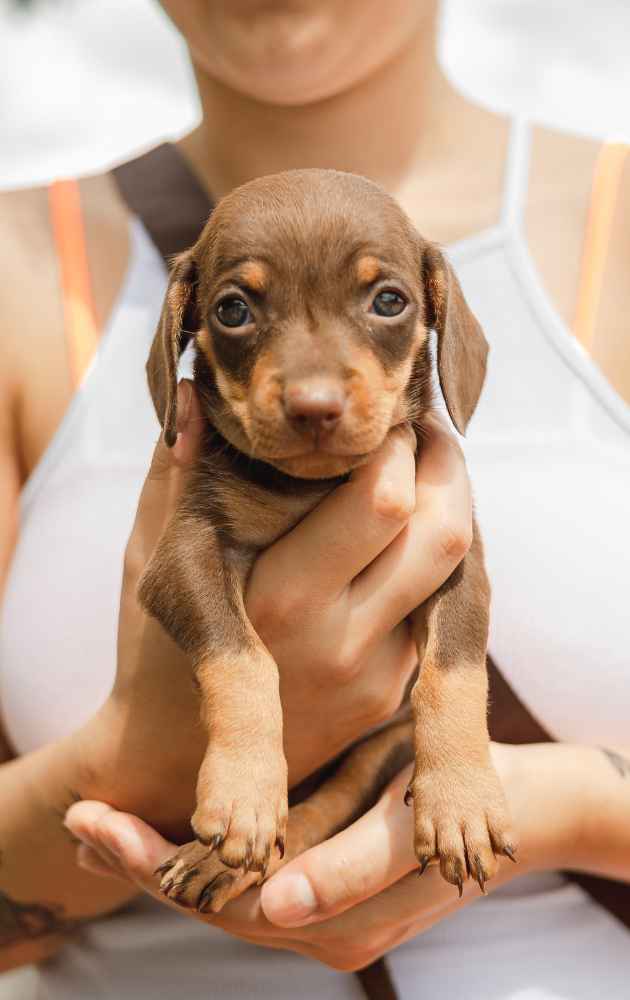
The socialization window for puppies closes at around 12-14 weeks. You have a narrow, specific period to expose your dachshund puppy to people, sounds, surfaces, and other animals – and what happens in that window shapes the adult dog they become.
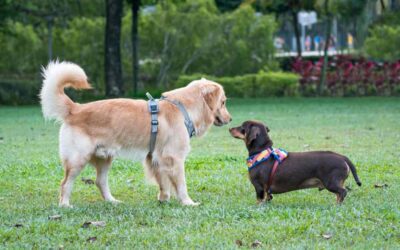
Dachshunds have a genetic tendency toward wariness with strangers that, without deliberate early exposure, can solidify into reactive barking or defensive snapping. This is preventable. Before your puppy is fully vaccinated, carry them to busy environments rather than skipping exposure entirely. Invite calm, known-healthy dogs for introductions. Let different people handle your puppy – including men with beards, people in hats, children.
On training: start immediately, keep sessions to five minutes maximum, and use food rewards exclusively at this age. Dachshunds are not stubborn so much as they are independent thinkers who need to understand what’s in it for them. Positive reinforcement works; harsh corrections don’t and typically backfire.
Housetraining requires schedule above all else. Take your puppy out every 45-60 minutes, immediately after waking, and immediately after eating. Reward outdoor toileting enthusiastically. Clean accidents without drama using enzymatic cleaner. Expect three to six months before accidents become genuinely rare with this breed.
The first vet visit
Your dachshund puppy’s first vet appointment should happen within 48-72 hours of bringing them home. Bring all breeder paperwork, confirm the vaccination schedule, and specifically ask your vet about IVDD prevention – not all vets will raise it unprompted.
The standard US puppy vaccination series covers distemper, parvovirus, adenovirus, and parainfluenza (given as DHPP), running from 6-8 weeks through 16 weeks with boosters every 3-4 weeks. Rabies is legally required in most states, given at 12-16 weeks. Bordetella is recommended for any puppy who will be around other dogs.
Also confirm flea, tick, and heartworm prevention at this visit – and don’t use over-the-counter flea treatments without checking age and weight appropriateness first. Some formulations are dangerous for young puppies. Save your nearest 24-hour emergency vet number before you leave home on collection day, not after you need it.
#What the first nights look like
The first two or three nights with a dachshund puppy are difficult. Your puppy has just left their mother and littermates, and they will likely cry. How consistently you respond sets a behavioral pattern that’s hard to undo later.
Crate in the bedroom helps significantly. Your breathing, your scent – it matters to a puppy in those first nights. Some owners add a soft toy with a heartbeat simulator or a warm (not hot) water bottle wrapped in a blanket. A worn t-shirt in the crate works well too.
The key is consistency. If you get up to comfort a crying puppy sometimes but not others, the crying escalates – the puppy has learned that persistence eventually produces a human. Decide in advance whether you’ll respond to distress versus normal settling whining, and stick to it. Genuine distress after a reasonable settling period may mean a bathroom trip is needed. By night four or five, the majority of dachshund puppies are sleeping through or close to it.

Day-one checklist
Before you leave to collect your dachshund puppy, confirm every item below is in place. Doing this the day before – not the morning of – removes the chaos of last-minute runs to the pet store.
- Crate set up with bedding, divider panel in place
- Same food the breeder has been feeding, ready to go
- Baby gates installed at stairs (top and bottom) and any off-limits rooms
- Ramp or dog steps next to sofa and bed
- Enzymatic cleaner purchased and accessible
- Stainless steel food and water bowls in place
- Step-in harness fitted and ready
- Vet appointment booked within 72 hours of pickup
- 24-hour emergency vet number saved in your phone
- All household members briefed: no rough handling, no letting the puppy jump off surfaces, no feeding from the table
On arrival, take your puppy directly to the designated toilet spot outside before bringing them indoors. Let them explore one room at a time. Keep greetings calm – dachshund puppies get overstimulated easily and excited greetings from five people at once are a recipe for accidents and a stressed puppy.
FAQ
How do I prepare my home for a dachshund puppy?
Preparing your home for a dachshund puppy means working through three priorities: hazard removal, furniture access control, and zone setup. Remove or secure every electrical cord, toxic substance (chocolate, xylitol, grapes, cleaning products), and unsecured trash can at floor level. Install baby gates at the top and bottom of all stairs before the puppy arrives – dachshund puppies should not navigate stairs unsupervised due to spinal impact risk. Set up a correctly sized crate in a location where the puppy can hear household activity. Place a ramp or dog steps next to every piece of furniture the puppy might want to access. Have enzymatic cleaner ready for housetraining accidents. These steps done before pickup day make the first week significantly more manageable.
What do I need to buy before getting a dachshund puppy?
The non-negotiable purchases before a dachshund puppy arrives are: a crate with a divider panel (24 inches for miniatures, 30 inches for standards), a step-in or H-style harness, enzymatic cleaner, at least two baby gates, a low dog ramp or steps, stainless steel food and water bowls, and a variety of chew toys. The harness is particularly important – collars put pressure on the neck and are inappropriate for a breed with spinal vulnerabilities. The ramp is equally critical from day one; letting a dachshund puppy jump freely on and off furniture contributes to cumulative disc damage that may not become apparent for years.
How long does it take to house train a dachshund puppy?
Most dachshund puppies take three to six months to housetrain reliably – longer than many other breeds. Consistency of schedule is the single biggest factor: taking the puppy outside every 45-60 minutes, immediately after waking, and immediately after eating. Reward outdoor toileting every time. Use enzymatic cleaner for accidents – regular cleaners leave a scent residue that draws the puppy back to the same spot. Never punish a puppy for an accident after the fact; they don’t connect your reaction to something that happened thirty seconds ago, and punishment typically makes housetraining slower, not faster.
What age should a dachshund puppy be when you bring them home?
Eight weeks is the minimum recommended age to bring a dachshund puppy home, and it is the legal minimum in most US states. Some reputable breeders hold miniature dachshunds until 10-12 weeks, citing the additional socialization benefits of extra litter time – there is genuine developmental value in that. Be cautious of any breeder offering puppies before eight weeks; early separation has documented negative effects on bite inhibition and social behavior. If a breeder is holding puppies beyond 12 weeks, ask specifically what socialization they have been providing – puppies kept in low-stimulation environments past 12 weeks may have missed critical exposure windows.
What should I feed a dachshund puppy?
Feed a high-quality small-breed or toy-breed puppy kibble with a named protein source (chicken, beef, salmon) listed as the first ingredient. Feed three times daily until six months of age, then move to twice daily. Measure every portion using the packaging guidelines as a starting point and adjust based on your puppy’s actual weight and growth rate. For miniature dachshund puppies, typical portions are around ¼ to ½ cup per meal, though this varies by formula. Weight management is critical with this breed – excess weight is one of the most controllable risk factors for IVDD, the spinal disease that affects roughly one in five dachshunds over their lifetime.
How do I protect my dachshund puppy’s spine?
Protecting a dachshund puppy’s spine requires three consistent habits from day one. First, prevent free jumping – install a ramp or low steps next to every sofa, chair, and bed the puppy accesses, and train ramp use early using food rewards. Second, lift correctly – always support both the chest and hindquarters simultaneously, keeping the spine horizontal. Never lift a dachshund by the front legs. Third, keep weight lean – measure all meals and avoid overfeeding, because every extra pound the dog carries adds disproportionate load to the spinal discs. IVDD affects an estimated 19-24% of dachshunds, but consistent prevention from puppyhood genuinely reduces cumulative disc stress.
Are dachshund puppies good for first-time dog owners?
Dachshunds can work well for first-time owners, but only those who go in with realistic expectations. They are not a low-maintenance starter dog. Housetraining takes longer than average. They are vocal, independent, and prone to separation anxiety if not properly introduced to alone time from puppyhood. Their spinal health requires ongoing management that most other breeds don’t demand. That said, the breed’s intelligence means they respond well to positive reinforcement training, and their size makes them manageable physically. A first-time owner who researches the breed thoroughly, commits to consistent training, and understands the IVDD risk profile can absolutely succeed with a dachshund – but going in underprepared tends to produce a frustrated owner and an under-managed dog.
How much does a dachshund puppy cost?
From a health-tested, reputable breeder in the US, expect to pay between $800 and $2,500 for a dachshund puppy. Miniatures typically sit at the higher end of that range; wire-haired dachshunds often cost more because reputable breeders of that coat type are harder to find. Prices significantly above $2,500 for standard colors warrant scrutiny – “rare” color marketing frequently signals inflated pricing rather than genuine rarity. Puppies priced below $500 are a red flag for puppy mill or backyard breeder origins. Dachshund-specific rescues operate across most of the US and charge $200-$400 in adoption fees – a legitimate option worth considering alongside breeder routes.
Conclusion
The preparation you do before your dachshund puppy arrives makes a genuine difference to how those first weeks unfold. The crate, the ramp, the enzymatic cleaner, the baby gates – none of it is overkill. Dachshunds are physically specific dogs with real vulnerability at the spine, and building good habits early is far easier than trying to undo bad ones later.
They will also be completely worth it. This is a breed of outsized personality, fierce loyalty, and genuine comedic timing. Go in prepared, go in honest with yourself about what the breed requires, and you’ll have a dog that makes very little sense and brings enormous joy.

0 Comments