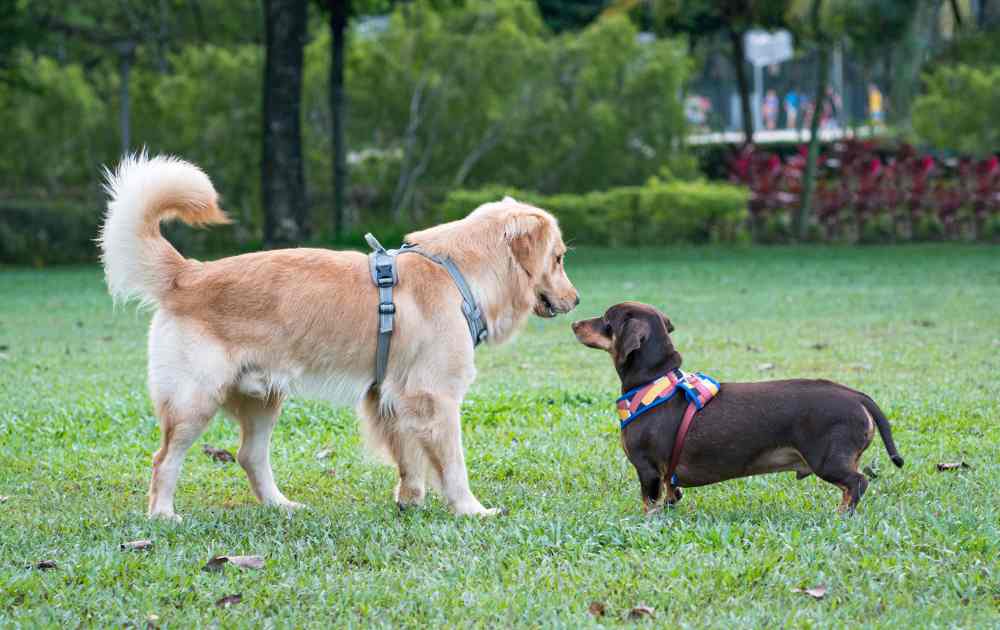
Safe dachshund playdates pair your dog with one or two familiar, similarly built dogs on flat, obstacle-free ground, in sessions of 15 to 20 minutes with full supervision. Because dachshunds carry a genetic predisposition to intervertebral disc disease (IVDD) – a spinal condition an estimated 19 to 24% of the breed will show signs of in their lifetime – safe play rules out wrestling with much larger dogs, tug-of-war, frisbee, and anything involving jumping or sharp twisting. Start socializing as early as your vet allows, and end every session before excitement tips into overstimulation.
Dachshunds pack a lot of personality into a small frame, and getting them comfortable around other dogs takes more thought than it does for breeds built for running and wrestling. This guide covers what actually matters for this breed specifically: the socialization window, how to protect a long spine during play, how to choose a playmate that won’t put your dog at risk, and what a genuinely relaxed dachshund looks like versus one that’s about to have a bad time.
Why socialization doesn’t come naturally to a dachshund
Most sporting and herding breeds were developed to work in close partnership with a handler, which is part of why a Labrador or a Border Collie tends to read as naturally biddable and social. Dachshunds weren’t built that way. The breed was developed in Germany to track and confront badgers underground, often alone or in a pair, making split-second decisions with no handler in sight. That history shows up at home as independence and a stubborn streak, and it shows up at playdates as a dog that doesn’t automatically default to easy, fluid group play the way a retriever might.
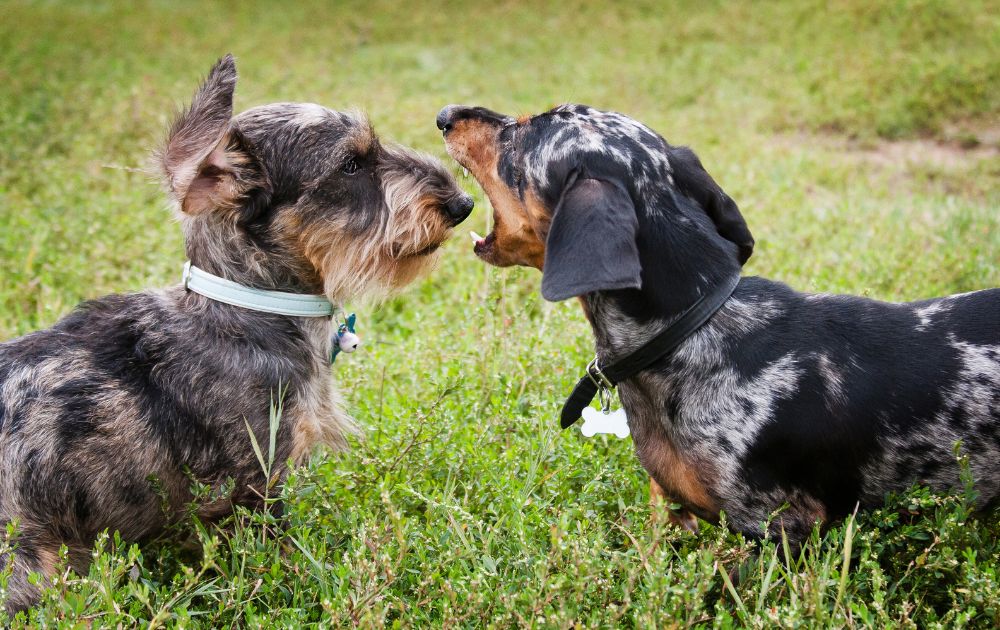
It also shows up as noise. The official AKC breed standard specifically credits the dachshund with a “loud tongue” – the traditional term for vocalizing while working a scent trail underground. A dachshund baying, yodeling, or barking steadily during a playdate is often just talking, not necessarily a warning sign, though it’s worth reading alongside body language rather than on its own (more on that below).
Prey drive is the other piece worth knowing before you set up a playdate. A dog bred to chase badgers, rabbits, and rodents into their dens can find fast, darting movement hard to ignore, whether that movement comes from a squirrel, a small dog, or a cat. This doesn’t rule out playdates with smaller or quicker dogs, but it’s a reason to introduce them carefully rather than assume goodwill on sight.
When to start: the critical socialization window
Veterinary behaviorists at the American Veterinary Society of Animal Behavior (AVSAB) place the critical socialization period for puppies at roughly 3 to 14 weeks of age. This is the window when a puppy’s brain is most open to filing new experiences under “normal” rather than “threat,” and it closes gradually as the dog matures. Since most puppies come home around 8 weeks old, that leaves about 6 weeks of prime window to work with.
The AVSAB’s position is that this window matters enough to start controlled socialization before a puppy’s vaccine series is finished, not after. One set of vaccines plus a first deworming, given at least 7 days before the first playdate or puppy class, is generally enough to begin safely in a controlled setting with known, healthy, vaccinated dogs. What to avoid during this early period is public dog parks and unscreened group settings, where exposure risk is harder to control.
If you’ve adopted an adult or rescue dachshund who missed this window entirely, it’s not a lost cause. Socialization is simply slower and more deliberate at that stage: shorter introductions, more repetition, and more patience for a dog that needs longer to decide a new dog is safe to be around.
The IVDD factor: what safe play actually means for a long-backed dog
This is the part most general dog-socialization advice skips, and it’s the part that matters most for this breed. Dachshunds are chondrodystrophic – built with a long spine, short legs, and discs that degenerate earlier and faster than in most other breeds. Research puts a dachshund’s IVDD risk at 10 to 12 times that of the average dog, with roughly 19 to 24% of the breed showing clinical signs at some point in their lives, most often between the ages of 3 and 7.
Play is exercise, and for a dachshund, not all exercise is created equal. A handful of movements show up again and again in veterinary guidance as specific triggers for disc injury.
Movements to avoid during play
- Wrestling with a much larger or heavier dog. Even friendly body-slamming can compress a dachshund’s spine in a way it isn’t built to absorb.
- Tug-of-war. The twisting and sudden yanking motion puts direct torque on the discs.
- Frisbee or any jump-to-catch game. A running leap, a mid-air twist, and a hard landing is one of the highest-risk movement combinations for a long-backed dog.
- Racing up and down stairs. Repeated stair use forces the spine through repeated flexion and extension, and it’s worse when a dog is running rather than walking.
- Jumping on and off furniture mid-chase. A playdate that spills onto a couch or bed turns every jump into a landing impact on the spine.
What safe play looks like instead
- Fetch with the toy rolled or tossed low along the ground, never thrown up for a leaping catch
- Flat-ground chase games on grass or another soft, even surface
- Supervised tunnel toys, which double as a fun nod to a dachshund’s den-hunting instincts
- Swimming, which is close to zero-impact on the spine when supervised
- Short, calm sniffing breaks built into the session as a natural pause
Two age groups need extra caution here. Puppies have growth plates that don’t fully close until around 12 months, so a bouncy puppy playdate should be shorter and gentler than it looks like it needs to be. Dachshunds over 7 are statistically in the highest-risk window for IVDD and do better with non-slip surfaces and noticeably calmer sessions.

Choosing playmates your dachshund’s body can handle
“Small dog” isn’t a safety guarantee on its own. The AKC breed standard splits dachshunds into standard (16 to 32 pounds) and miniature (11 pounds and under, with 11 to 16 pounds informally called “tweenie”), and a bouncy 28-pound standard dachshund can be just as hard on a 9-pound miniature as a much bigger breed would be. Match by build and play style, not just by the word “small.”
Look for playmates that play low to the ground rather than dogs that jump, tackle, or lean on their weight to play. A calm, established dog your dachshund already knows is a safer starting point than a new dog at a busy park, and it’s worth watching how a potential playmate responds when your dachshund tries to disengage. A dog that backs off when the other dog turns away or freezes is a good sign. A dog that keeps chasing, mounting, or pouncing regardless is worth separating from, no matter how small or well-meaning it seems.
Picking a dachshund-safe location
A flat, enclosed space with no obstacles beats a public dog park with agility equipment, A-frames, or raised platforms nearly every time. Before the first playdate, walk the space yourself and check for anything that turns a chase into a fall: pool edges, decking with a drop-off, furniture the dogs could climb onto mid-game, and open stairs.
Fencing matters more for this breed than most. Dachshunds dig with real enthusiasm – it’s part of the same instinct that makes them good at den work – so a fence line needs to be secure at ground level, not just tall.
Dog parks aren’t off-limits, but they work better as a supplement than a starting point. Go during quiet hours, know the layout before you’re relying on it mid-scuffle, keep the visit shorter than you think you need to, and be ready to leash up and leave if a boisterous dog latches onto your dachshund and won’t take the hint.
Reading your dachshund’s body language
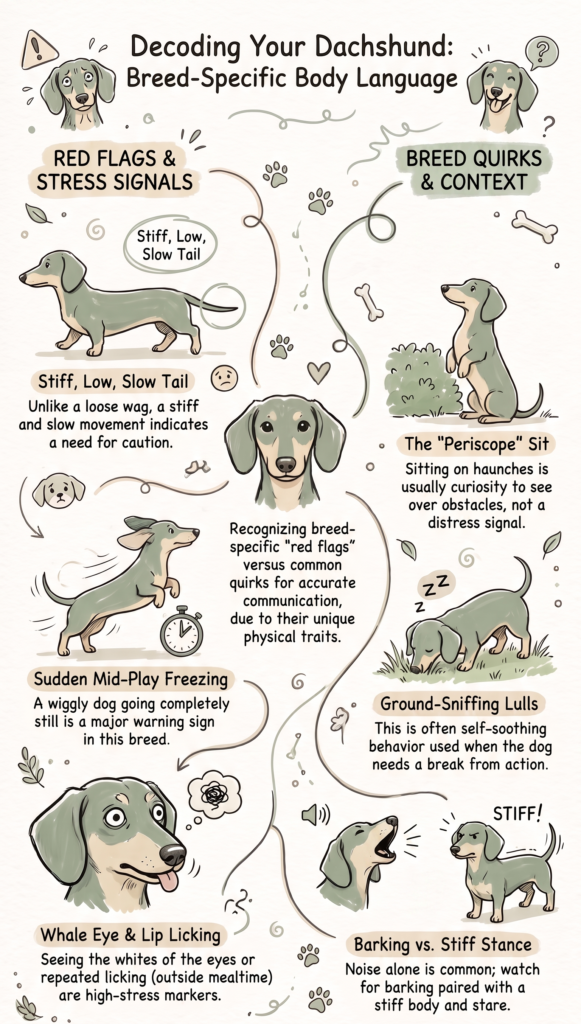
Generic “watch for a tucked tail” advice doesn’t translate cleanly to a breed with a naturally low-set tail to begin with. Here’s what to actually watch for:
- Tail carriage and movement, not just position. A loose, wide wag paired with a relaxed body is a good sign. A tail that goes low, stiff, and slow – even if it’s technically still moving – is the one to pay attention to.
- Sudden freezing. A normally wiggly, low-to-the-ground dog going completely still mid-play is a bigger red flag in this breed than in one that’s naturally more upright and reserved.
- “Periscoping.” Sitting up on the haunches to see over grass or other dogs is a dachshund party trick, not automatically a distress signal, but it’s worth a glance at what prompted it.
- Excessive ground-sniffing during a lull. A classic self-soothing behavior when a dog wants a beat away from the action.
- Barking and baying on their own aren’t the tell. Given the breed’s “loud tongue,” vocalizing during play is often just noise. What’s actually worth watching is barking paired with a stiff, low body and a hard stare. That combination, not the volume, is what signals things are escalating.
- Whale eye (whites of the eyes showing) and repeated lip-licking outside of mealtime are additional stress markers worth separating dogs over.
A wagging tail doesn’t cancel out a stiff body. If you see the two together, treat it as a warning and take a short break regardless of how the tail looks.
Hosting tips that fit a dachshund’s stamina
- Keep it short. Fifteen to twenty minutes is plenty for a first session. Short legs and a long torso tire out faster than most owners plan for, and fatigue is exactly when sloppy, injury-prone movement creeps in.
- Supervise the entire time. Even with a playmate your dog knows well, don’t leave the dogs unattended.
- Build in water and shade breaks, especially in warm weather.
- Choose toys that stay low. Ground-rolled balls and soft tug-free toys beat anything thrown high or used for a game of tug.
- End while it’s still fun. Call the session before overstimulation has a chance to tip into a scuffle, using the body language cues above as your signal.
Mistakes that are easy to make with this breed
- Assuming small automatically means gentle. Plenty of small breeds play just as rough as large ones.
- Letting a much bigger dog “gently” wrestle because he seems friendly. Friendly and safe aren’t the same thing for a dog with a long spine.
- Treating stairs, decks, or raised furniture at the playdate location as neutral ground. They’re not, and dogs rarely respect them as boundaries mid-chase.
- Being inconsistent. One playdate a month doesn’t build lasting social skills the way shorter, more regular exposure does.
- Reading the tail and stopping there. A wagging tail next to a stiff body is still a warning sign, not a green light.
When playdates aren’t going well
Real aggression – repeated growling or snapping paired with a stiff body, not just noise. Such behavior is worth bringing to a professional trainer or behaviorist, ideally one with experience in small or chondrodystrophic breeds. Handling techniques built for large-breed reactivity don’t always translate well to a dachshund’s size and build.
Shyness or fear responds better to slow desensitization than to being pushed. Parallel leashed walks alongside another dog, with no expectation of direct interaction, are a good stepping stone before off-leash play.
Selective hearing during recall is common in this breed and tends to reflect their independent streak more than anything playdate-specific. It’s worth working on recall separately so a playdate doesn’t become the only place it gets tested.
Tight one-person attachment shows up in some dachshunds as stress around playdates that has more to do with being away from their person than with the other dog. Gradual confidence-building, rather than more frequent playdates, tends to help here.
Alternatives and additions to traditional playdates
- AKC Earthdog tests. This one is genuinely dachshund-specific: dogs six months and older can try an instinct test built around scent trails, tunnels, and den work, tapping directly into what the breed was built to do. It’s a good outlet for dogs with strong digging or hunting instincts.
- Scent work or nose work classes. These use a dachshund’s strongest sense without any of the physical risk that comes with off-leash play.
- Structured puppy socialization classes with a trainer who screens attendees for compatible size and play style, rather than open-enrollment classes that mix any dog that shows up.
- Local dachshund meetups or breed clubs. Matched by breed, playmates tend to be matched by movement style and size too, which lowers injury risk compared to a mixed dog park.
- Parallel “sniff and walk” dates. Side-by-side leashed walks are a lower-stakes way to build comfort with a new dog before trying off-leash play.

Frequently asked questions
What age can I start socializing my dachshund puppy?
As early as your vet allows – typically once your puppy has had one set of vaccines and a first deworming, at least 7 days before the first controlled introduction. The prime socialization window closes by around 14 weeks, so earlier, careful exposure matters more than waiting for full vaccination.
Is it safe for a dachshund to play with big dogs?
It can be, if the bigger dog is calm, well-trained, and gentle, and if you supervise closely and step in at the first sign of wrestling, body-slamming, or chasing that could knock your dachshund over. Given the breed’s IVDD risk, most vets recommend matching playmates by size and play style rather than ruling out big dogs entirely.
How long should a dachshund playdate last?
Fifteen to twenty minutes is a good starting point, especially for puppies and seniors. You can extend it once you know how your specific dog handles a session, but ending on a calm note beats pushing for a longer visit.
My dachshund barks nonstop when playing with other dogs. Is that a problem?
Usually not on its own. The breed standard specifically calls for a “loud tongue,” and barking or baying during play is often just how a dachshund talks. Watch for barking combined with a stiff, low body and a hard stare rather than the noise itself.
Can two dachshunds of the same sex play together safely?
In most cases, yes, especially if they’re introduced gradually and matched in size and energy. Compatibility comes down to individual temperament more than sex, though intact males meeting for the first time may need a slower introduction.
Are dog parks safe for dachshunds?
They work better as an occasional supplement than a primary socialization tool. Look for flat ground without agility equipment, visit during quieter hours, and be ready to leash up and leave if another dog won’t stop chasing or mounting your dachshund.
My rescue dachshund is an adult and was never socialized. Is it too late?
It’s not too late. It takes more patience than working with a puppy inside the critical window, but adult and senior dachshunds do learn to feel safer around other dogs with slow, repeated, positive exposure. Start with calm, known dogs and short sessions rather than group settings.
Should I let my dachshund play tug-of-war?
It’s best avoided. The twisting and yanking motion puts direct strain on a dachshund’s spine, which makes it one of the higher-risk games for a breed already prone to IVDD.
How do I know if my dachshund is overstimulated rather than just having fun?
Watch for the body language shifting from loose and wiggly toward stiff and low, along with sudden freezing, whale eye, or repeated lip-licking. A wagging tail next to a stiff body still counts as a warning sign, not a reassurance.
How often should dachshunds have playdates?
Regular, shorter sessions build social skills more reliably than occasional long ones. A weekly or biweekly playdate with a familiar, well-matched dog tends to work better than one long visit a month.
Key takeaways
Dachshund playdates are worth the effort. They build a more confident, better-adjusted dog, and for a breed this people-oriented, they’re genuinely good enrichment. The difference between a good playdate and a trip to the vet usually comes down to a few things generic dog advice doesn’t cover: a flat, obstacle-free space, a playmate matched by build rather than just size, sessions that end before fatigue sets in, and body language read with a long, low-set dog in mind rather than a generic dog silhouette. Start early where you can, go slow with dogs who missed that window, and let your dachshund’s spine set the boundaries on how rough play is allowed to get.

About the author

This guide was researched and written by the Dachshunds Planet editorial team, drawing on veterinary and behavioral research alongside hands-on dachshund ownership. Dachshunds Planet covers dachshund health, training, and daily care with a focus on breed-specific detail – especially IVDD – that generic dog-care content tends to miss.


0 Comments