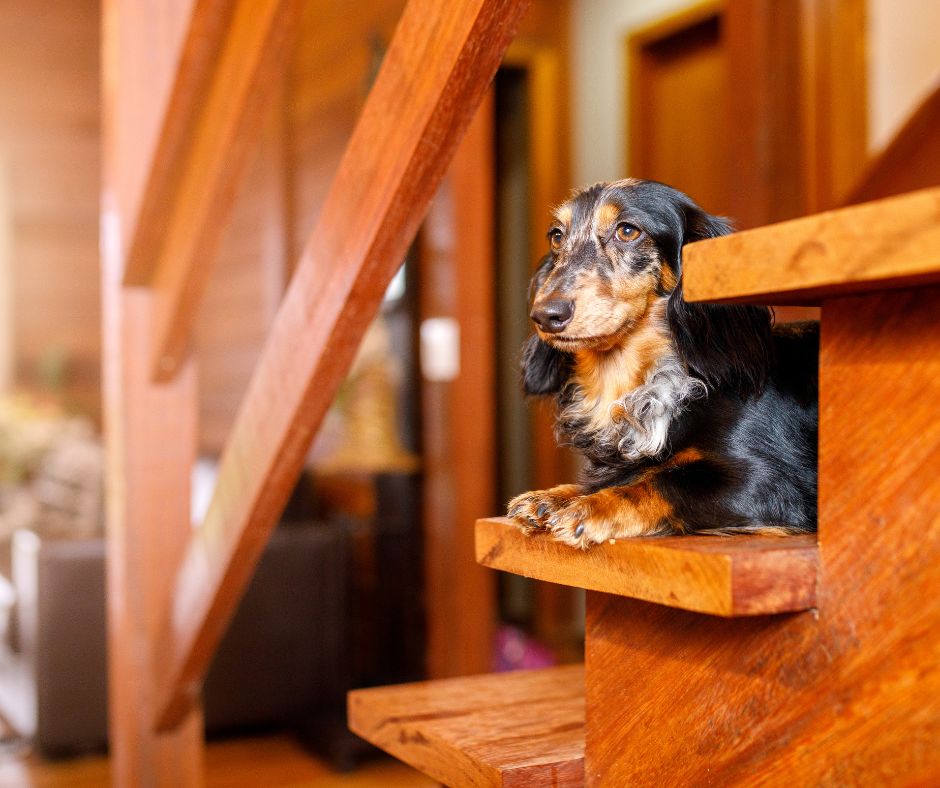
Dachshunds should not climb stairs regularly – especially up. Repeated stair use puts direct pressure on the spine and significantly increases the risk of IVDD (intervertebral disc disease), which affects up to 25% of the breed. Puppies under 12 months and seniors over 8 years are at the highest risk. That said, newer research shows the picture is more nuanced than an absolute “never” – and this article breaks down exactly what the science says.
Why stairs are dangerous for dachshunds
To understand why stairs are a potential time bomb for dachshunds, you need to look at what’s happening underneath that low-slung body.
The anatomy that changes everything
Dachshunds are the result of deliberate selective breeding – they were developed to work in burrows, so the body had to be long and low. The problem is that the same build that made them effective hunters now puts their spine under serious pressure.
The numbers tell the story: an ideal dachshund has a height-to-body-length ratio of 1:1.7-1.8. Think of it like building a bridge with an enormous span but very short support pillars. This characteristic silhouette is caused by chondrodystrophy – a cartilage development disorder that shortens the limb bones while leaving the spine at normal length.
And here’s where it gets complicated: the same gene that gives dachshunds their shape also causes premature calcification of the intervertebral discs. MRI studies show that even in young, healthy dachshunds (24-31 months old), most discs already show signs of degeneration.
What actually happens at each step
Think of the spine as a series of cushions – the intervertebral discs – sitting between the vertebrae. In most dogs, the limbs absorb the majority of the impact when climbing stairs. In dachshunds? Those short legs don’t provide enough leverage, so the load transfers directly to the joints between the vertebrae.
The worst part: the highest concentration of stress lands at the junction between the thoracic and lumbar spine – specifically Th13-L1. That’s exactly where disc herniation most commonly occurs. That’s where IVDD begins.
Going up, a dachshund has to make exaggerated oscillating movements with the spine to push the body onto each step. Going down is even more extreme – the front legs absorb the kinetic energy of the body dropping forward, causing a sharp flexion of the spine. Every step is a micro-impact travelling along discs that are already under strain.
The statistics
According to the large-scale Dachs-Life 2015 study, between 19% and 24% of dachshunds will experience IVDD during their lifetime. That’s a risk 10-12 times higher than in non-chondrodystrophic breeds.
And not all dachshunds carry the same level of risk:
| Variety | IVDD frequency |
|---|---|
| Standard smooth-haired | 24.4% |
| Miniature smooth-haired | approx. 20-29% |
| Miniature wire-haired | 16.5% |
| Miniature long-haired | 15-16% |
| Standard long-haired | 9.4-10% |
| Standard wire-haired | 7.1-8.6% (lowest risk) |
Age is another major factor:
- Puppy (under 12 months) – critical risk. The skeleton is still developing, vertebrae are not fully mineralised
- Young adult (1-3 years) – low to moderate. Disc degeneration has started, but the dog is at peak physical fitness
- Adult (3-7 years) – high. Micro-injuries accumulate, disc elasticity decreases
- Senior (over 8 years) – very high. Progressive calcification combined with weakening stabilising muscles

When a dachshund can use stairs – the exceptions
This is where things get interesting. Traditional veterinary thinking was categorical: zero stairs, never, under any circumstances. But newer research has started to challenge that absolute position.
The “movement is health” debate
It turns out that dogs kept completely still can develop weakened musculature – which paradoxically makes their spine more vulnerable to injury from an unexpected jump. Scandinavian research suggests that moderate stair use may actually reduce the rate of disc calcification by improving tissue metabolism and strengthening the muscles along the spine.
Strong muscles – including the multifidus – act as a dynamic corset around the spine. And here’s the key distinction: one calm walk up a few steps for a dog in excellent condition is a completely different thing from multiple trips up and down full flights every day.
The Dachs-Life 2015 study found something striking:
| Activity level | IVDD risk | What it means |
|---|---|---|
| High (over 1 hour of walking daily) | 0.5x lower | Activity strengthens the muscular corset |
| Moderate (stairs daily) | 1.4-1.6x lower | Tissue adaptation to load |
| Low (under 30 min walking) | 1.8x higher | Muscle atrophy, excess weight on vertebrae |
You read that right – dogs that use stairs daily in a moderate way have a lower risk of IVDD than those living a sedentary life.
Who can manage stairs?
We’re talking about a very specific group: young, healthy dachshunds (2-6 years old), lean (ideal Body Condition Score 4-5/9), well-muscled, with no signs of pain. If your dog meets all of those criteria, a few steps at the front door each day is not necessarily a disaster.
The key word is “moderate.” This is not a green light for daily sprints up to the second floor.
How to do it safely – if you have to
If stair use is unavoidable, follow these rules:
- Control the pace – the dog moves slowly, one step at a time. A short lead is essential – it prevents excited bolting
- Stay close – walk beside or just behind your dog, ready to catch them if they lose balance
- Physical support – gently support the dog under the belly to reduce pressure on the lumbar vertebrae
- No jumping – skipping the last few steps is a direct route to disc herniation. Zero tolerance
- Surface – stairs must be non-slip. Polished wood or marble are not safe options
Safe alternatives to stairs
The good news: there are ways for your dachshund to live fully without the risks that stairs bring.
How to carry a dachshund correctly – it’s not as obvious as you’d think
Most people pick dachshunds up wrong. You’ve probably seen someone grab a dog under the armpits and let the back half hang freely. That’s a recipe for injury.
The two-point rule:
- Point 1: One hand under the chest, between the front legs – stabilises the front half of the body
- Point 2: The other hand firmly supporting the hindquarters and thighs – eliminates any dangling of the back legs
- The horizontal rule: The spine must always be level, parallel to the ground. Hold the dog against your body for extra stability
Never hold a dachshund by the chest alone. This causes the spine to bow – exactly what you’re trying to avoid.
Ramps for dachshunds
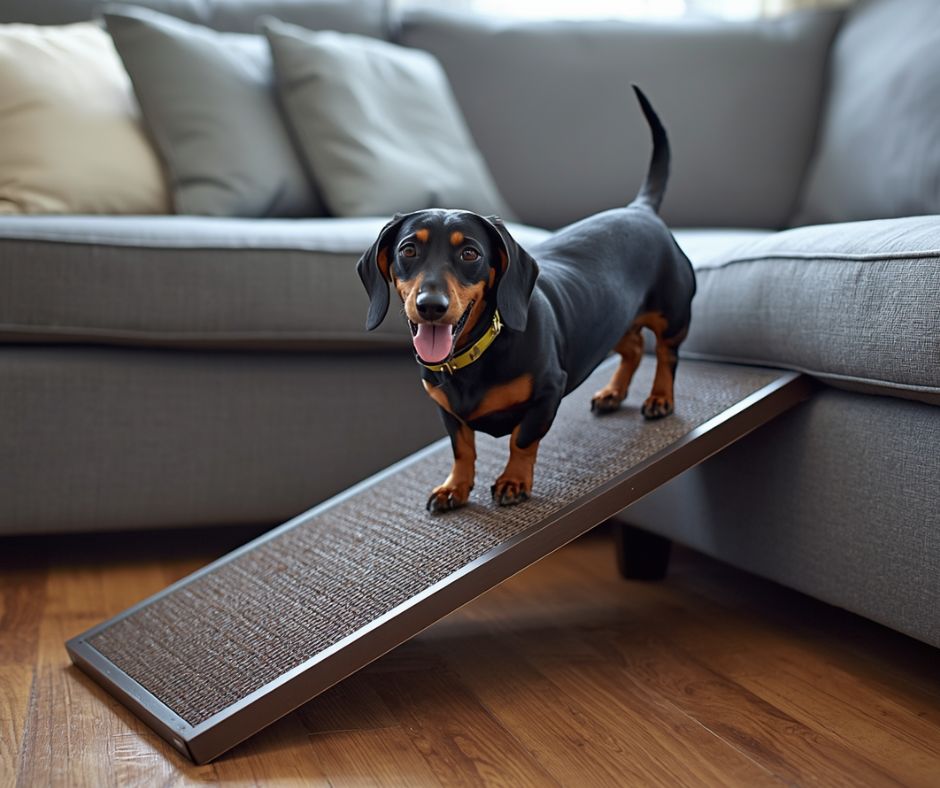
Ramps are the best alternative. Unlike stairs, they allow impact-free movement, which drastically reduces the load on the intervertebral discs.
What to look for in a ramp:
- Angle – the ideal ramp sits between 18 and 26 degrees. Too steep and the dog has to overwork the muscles, which recreates the problem you’re trying to solve
- Traction – the surface must have high grip – ribbed rubber or dense carpet. Slipping leads to muscle micro-injuries
- Side edges – quality ramps have raised sides that prevent the dog from accidentally sliding off
| Ramp type | Where to use | Main benefit |
|---|---|---|
| Bed ramp (tall) | Bedroom | Adjustable height, long run-up surface |
| Sofa ramp (low) | Living room | Compact, easy to move |
| Outdoor ramp | Garden/patio | Weather-resistant, non-slip |
The lift – not a luxury, a necessity
In apartment buildings, the lift is not optional – it’s essential. If the lift is temporarily out of order, the dachshund must be carried up the stairs. For seniors especially, consider a specialist dog carrier or pet stroller.
How to train your dachshund to wait at the stairs
Even if you plan to carry your dog, a high-energy dachshund will often try to bolt up the stairs before you can react. That’s why impulse control training is a safety fundamental.
Step-by-step training
All of this is built on positive reinforcement. You’re building trust and cooperation, not fear.
- Stage 1: Impulse control at the food bowl – Before putting the bowl down, hold it up and give the “wait” command. If the dog sits and makes eye contact, place the bowl on the floor – but only allow eating after a release word (for example “okay”). This teaches that good things come to those who wait.
- Stage 2: “Wait” at doorways – Practice stopping before open doors. Your dog needs to understand that an open space doesn’t mean automatic movement. This is generalisation – learning to stop in different contexts.
- Stage 3: Applying it at the stairs – Approach the stairs on lead. Stop at the first step. Give the “wait” command and reward calm standing with a treat. Repeat until the dog starts stopping at the stairs automatically.
- Stage 4: Being lifted as the reward – Associate the waiting moment at the stairs with being picked up. The dog should learn that stairs are where you wait for your human. Simple: I wait – I get the VIP lift.
Positive reinforcement – why a clicker helps
A clicker or a marker word (for example “yes!”) lets you pinpoint the exact moment your dog did the right thing. The reward – a high-value treat like dried lung, fish treats, or chicken – must follow the marker immediately.
Training should be built on motivation, not fear. Punishment creates anxiety, and anxiety can push a dog to flee – straight up the stairs.
Common mistakes
- Inconsistency – letting the dog run up “just this once” when you’re in a hurry undoes the training. The dog learns the rules are negotiable.
- Punishment-based methods – shouting creates stress, not obedience. If the dog associates stairs with being yelled at, they’ll want to escape there, not wait patiently.
- Moving too fast – expecting a dog to wait off-lead in a new, exciting location after three sessions. Learning takes time and repetition.
Summary – how to protect your dachshund’s spine
Managing a dachshund’s spinal health isn’t one big gesture – it’s a set of small, consistent daily decisions. Limiting stair use is one of the most important pillars, but not the only one.
- Body weight – keep a lean physique (BCS 4-5/9). Every extra kilogram is constant pressure on the vertebrae. Obesity increases injury risk by 1.67 times
- Activity – daily walks (minimum 1 hour) build the muscular corset around the spine. The key is movement on flat ground, not hill climbing
- Home environment – ramps at furniture and stairs eliminate impact forces. An investment that pays for itself
- Grooming – regular nail trimming gives stability on slippery surfaces. Long nails mean lost traction and higher fall risk
- Diagnostics – screening (X-ray/MRI) allows early detection of disc calcification before clinical symptoms appear
The key is consistency. A dachshund is a high-intelligence, high-energy dog – treat them like the working dog they are, and give them a safe framework for activity. Avoiding stairs, carrying correctly, and maintaining physical condition is an investment in a pain-free life well into old age.
If you notice any warning signs – neck stiffness, muscle tremors, a change in gait, reluctance to jump, signs of pain when the back is touched – don’t wait. Contact a veterinary neurologist immediately. With IVDD, time is everything.
FAQ
Are stairs going down safer than stairs going up?
Actually, the opposite is true. Going down is considered significantly more damaging to the dachshund’s spine than going up. When descending, the head and chest tip forward, so gravity and the body’s momentum both concentrate at the thoracic-lumbar junction. Every step is a micro-impact travelling along already-stressed discs. If you have to choose, it’s better to let your dog walk up than down.
At what age can a dachshund use stairs?
Full stair avoidance is recommended until at least 12 months. Some experts advise waiting until 18 months, when skeletal mineralisation is fully complete. Loading a developing skeleton early significantly increases the risk of disc degeneration later in life. A puppy’s enthusiasm is not worth paralysis in adulthood.
What if my dachshund has already been using stairs?
If the dog is healthy and fit, start prevention immediately: reduce stair use, introduce home ramps, begin carrying your dog in high-risk situations. A vet check-up to assess spinal condition and muscular fitness is a good idea. Regular activity on flat ground will help maintain the stabilising muscles. It’s not too late to change habits.
Are outdoor stairs worse than indoor ones?
Yes. Outdoor stairs carry additional risks. They’re often made of hard materials – concrete, metal – that absorb less impact. Weather conditions like rain, ice and snow also make them slippery, which dramatically increases the risk of a fall and sudden spinal injury. If you have outdoor steps leading to your home, invest in non-slip covers or consider a small ramp.
How many steps is too many?
There’s no truly safe number of steps if the movement is repetitive. More than 2-3 steps (for example at a front door) generally warrants attention – or a small ramp. For full flights, carrying should be the default regardless of the dog’s age. This isn’t about being overprotective – it’s about keeping your dog healthy for years to come.
Are foam pet steps a good alternative to a ramp?
Foam steps are better than regular stairs, but still not as good as a ramp. They still generate the same impact forces at each step – just on a smaller scale. A ramp eliminates impact entirely. If space is limited and steps are your only option, choose a model with small, closely-spaced steps and a non-slip surface.



0 Comments